Strength After 50: Why Building Muscle Isn’t Enough
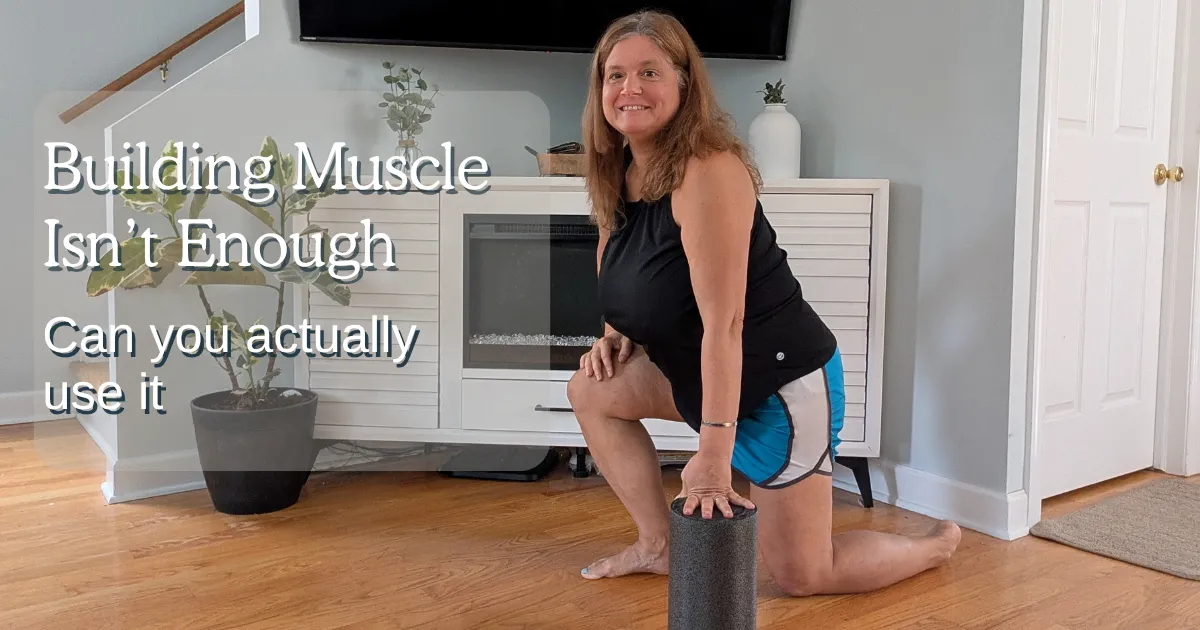
Building Muscle Isn’t Enough. Can You Actually Use It?
We hear a lot about building muscle as we age. Lift weights. Eat more protein. Add progressive overload. And yes, muscle matters. Starting somewhere in our 30s, we naturally begin losing muscle mass and strength as part of the aging process, and without enough of the right stimulus, that loss can continue as the decades pass.
But after 30 years as a physical therapist, I think we’re missing an important part of the conversation.
Building muscle isn’t the end goal. Being able to use it is.
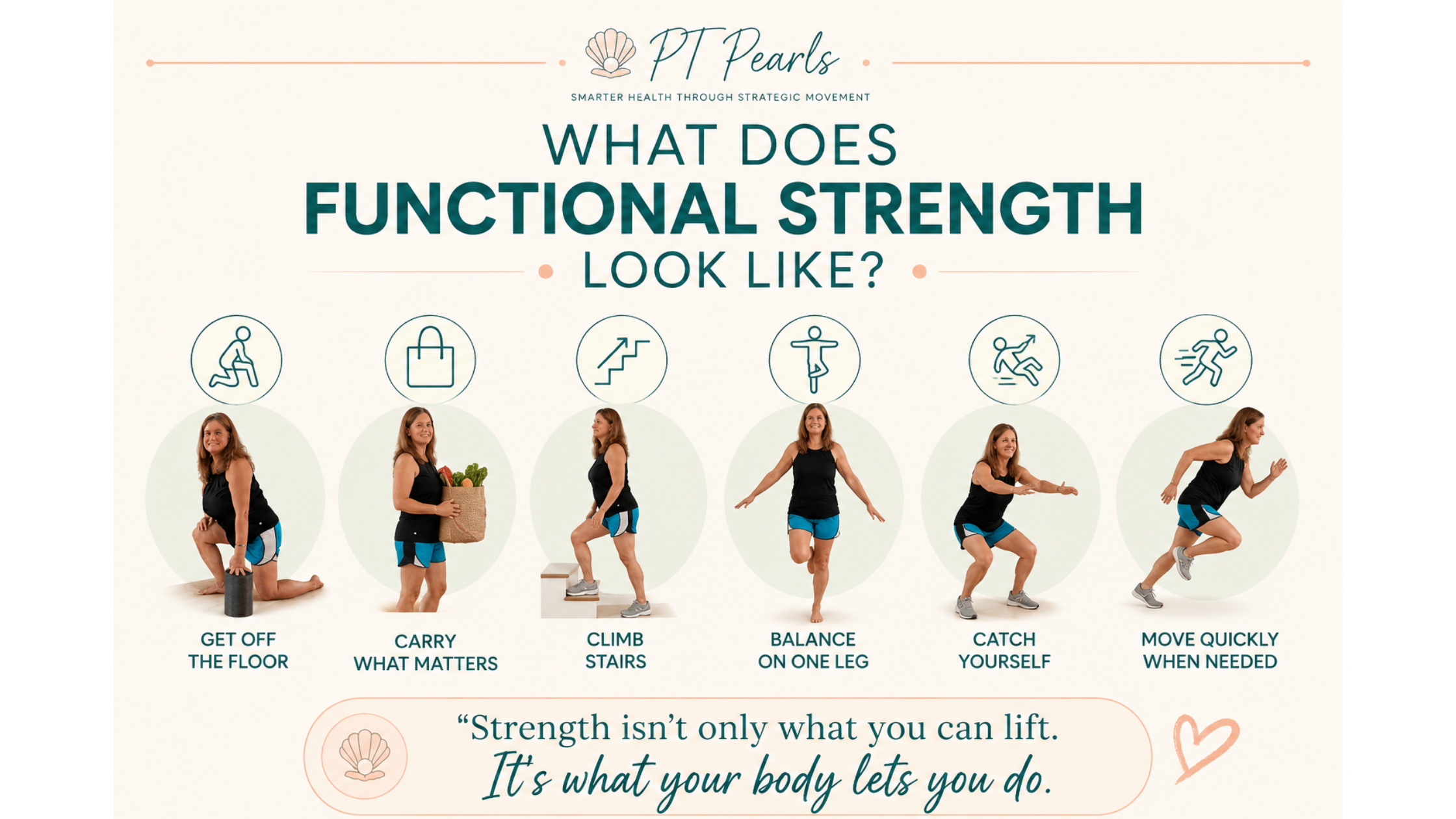
Your body doesn’t care how much you can leg press when you need to get off the floor. The number on your dumbbell doesn’t matter much if you lose your balance stepping off a curb. And toned legs are great, but I also want those legs to help you climb stairs, carry your grandchild, haul groceries into the house, move quickly across a street, or catch yourself when you trip.
Those moments require more than muscle. They require strength, stability, control, and power working together.
Strength Loss Doesn’t Always Look Like Weakness
Most people don’t wake up one morning and suddenly realize they’re weaker. The changes tend to happen gradually enough that we adapt without really noticing them.
Maybe your walking pace slows or you aren’t comfortable going quite as far. You stop getting down on the floor because getting back up has become harder, or you no longer spend time on your hands and knees. Opening jars gets tougher. Grocery bags get lighter, you make more trips, or you start asking someone else to carry them.
The changes can show up recreationally too. Jogging disappears. You stop jumping. Activities that require a quick push-off or change of direction don’t feel as comfortable anymore. Stairs become something you take more slowly instead of bounding up without thinking about it.
None of those things necessarily makes someone say, “I’m losing muscle.”
Instead, we adjust. We stop doing certain things, find another way to do them, or ask someone else to do them for us. Eventually, those little accommodations can become our new normal.
Pay attention to the things you’ve stopped doing, not only the things that hurt. Sometimes that’s where declining strength and function show up first.
Muscle Matters, But Muscle Has a Job to Do
Maintaining muscle as we age matters for a long list of reasons. Muscle helps us generate force, supports our joints, contributes to metabolic health, and gives us the physical capacity we need for work, recreation, travel, caregiving, and all the ordinary things we want to keep doing.
And let’s not pretend appearance doesn’t matter at all. Most of us would prefer to look trim, strong, and toned. There is nothing wrong with wanting to feel confident in your body and liking what you see in the mirror.
But looking muscular and being functionally strong aren’t necessarily the same thing.
I’m much more interested in whether you have muscle you can actually use. Can it help you produce force when you need it? Can you control that force? Can you stabilize your body, react quickly, and move through the positions real life requires?
That’s where the strength conversation gets more interesting.
Your Muscles Need to Produce Force and Control It
Think about something as ordinary as walking down a flight of stairs. Your muscles aren’t simply moving you. They’re controlling your body as gravity pulls you downward. Lower yourself slowly into a chair instead of dropping into it, and you’re doing the same thing.
Standing on one leg to put on your pants adds stability. Getting yourself off the floor requires mobility, strength, stability, and coordination to work together.
Running across the street before the light changes, catching yourself after a stumble, or quickly climbing a flight of stairs adds another component: power.
Power deserves special attention as we age. A 2025 prospective study of 3,889 adults ages 46 to 75 found that relative muscle power was a stronger predictor of mortality than relative muscle strength. Power combines force with speed, which helps explain why it matters so much for the quick reactions real life sometimes demands.
I recently talked with Prevention about this bigger longevity conversation and why strength training matters far beyond looking toned. Muscle gives us strength, stability, control, balance, and power, all things that affect what we can continue doing for ourselves as we age.
Real life asks your muscles to do all of this. They have to accelerate and decelerate, push and pull, lengthen and shorten, stabilize and move. Sometimes you’re on two feet. Sometimes you’re on one. The speed, direction, position, and load are constantly changing.
Your body needs to produce force, but it also needs to control it.
That’s why my definition of strength training goes well beyond simply adding another five pounds to the bar.
Don’t Forget the Other Half of the Strength Puzzle
Progressive resistance is important, but there’s another piece I see people overlook all the time: stability.
Sometimes people are so focused on lifting more weight that they haven’t built enough control to manage the weight they’re already using. Their trunk shifts, their knee collapses inward, their range gets smaller, or momentum starts doing part of the work. Other areas of the body jump in to compensate because the muscles we’re supposedly training can’t adequately stabilize and control the load.
That’s not the kind of progression I’m looking for.
Before we keep increasing load, I want to know that you can control your body and the weight you’re using. Depending on the person, that might mean core work, isometrics, balance training, scapular stabilization, slowing an exercise down, improving range of motion, or changing the base of support.
Sometimes the smartest progression isn’t more weight. It’s better control.
This Is Why I Teach Movement Patterns, Not Random Exercises
In my last blog, I focused on one movement I believe you cannot afford to lose: the squat. It’s one of our foundational patterns and an incredibly useful place to start, but life doesn’t happen in a squat.
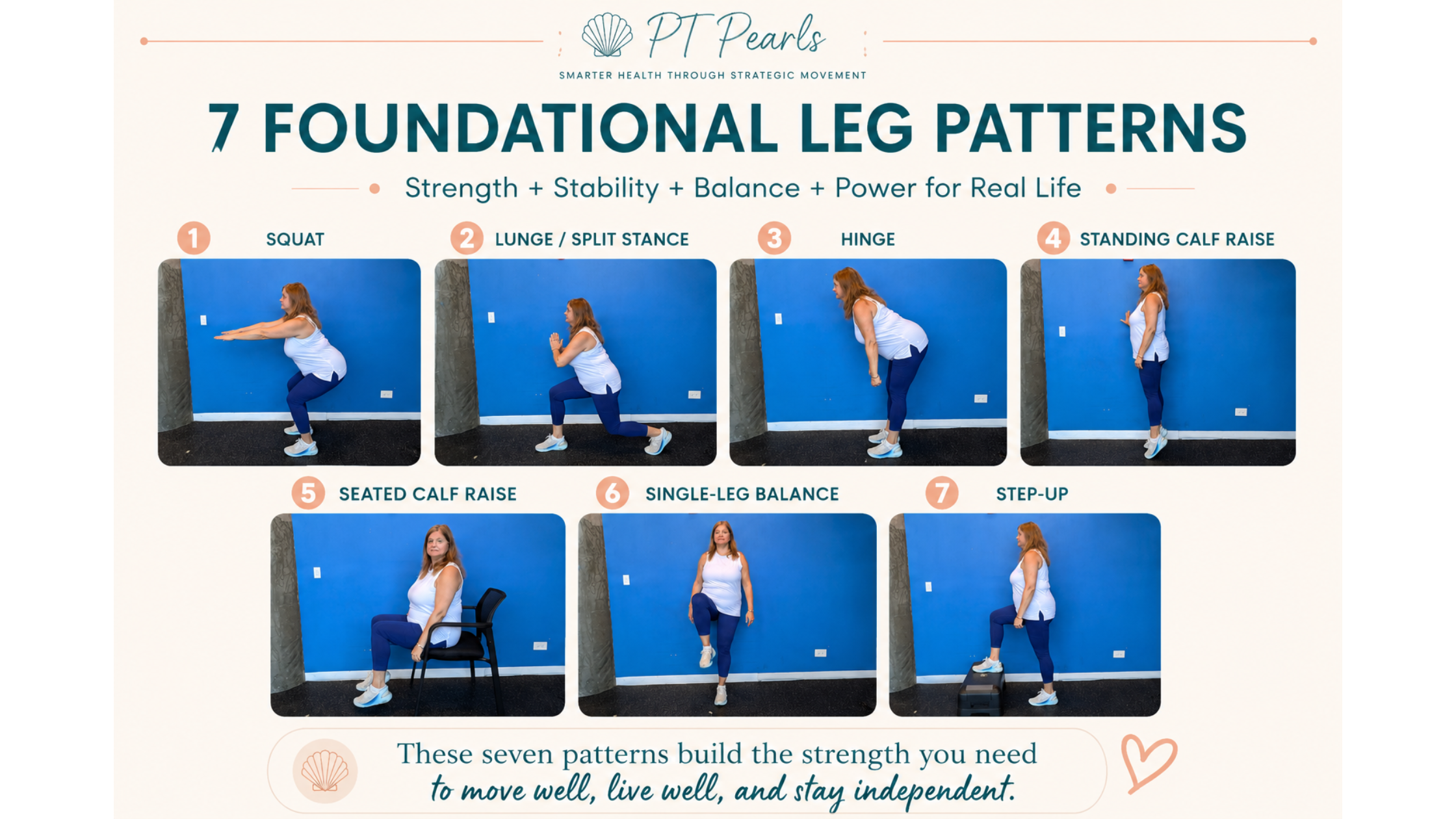
That’s why I expanded that conversation into seven foundational leg patterns. We’re taking the basic idea of lower-body strength and asking your body to solve different problems.
We move from a squat into split stance and lunging patterns, where your base of support changes and balance becomes more challenging. We hinge and train the glutes and backside of the body. We work the calves in standing and seated positions, and we add single-leg balance because the hip and calf play important roles in how we stabilize and react. Step-ups bring us back to one of the most practical activities we need to preserve: climbing.
Some patterns emphasize strength. Others increase the stability requirement. Some begin introducing the ability to produce force more quickly. Together, they give us a much better picture of what functional lower-body strength actually looks like.
Your body doesn’t live, work, and play in one position or one direction. Your strength training shouldn’t either.
Progress Doesn’t Always Mean Heavier
Progressive overload matters because your body needs a reason to adapt. Where I think the message sometimes gets lost is when “progressive overload” gets translated into “keep adding more weight.”
Load is one way to change the challenge, but it isn’t the only one.
You can increase range of motion, change position or direction, slow down the lowering phase, change repetitions, increase time under tension, narrow the base of support, or progress from two limbs to one. You can ask the body to generate force more quickly or control deceleration more effectively.
There are also tools that allow us to change the stimulus in other ways.
Blood flow restriction training, or BFR, is one I use both personally and professionally because it allows us to challenge muscle using lighter loads. For a busy adult, an aging body, or someone dealing with degenerative changes, previous injuries, or joints that don’t appreciate continually increasing external load, that can open another door.
VA NOTE: BACKLINK “blood flow restriction training” to the most appropriate existing PT Pearls BFR article/resource. Do NOT insert the BFR affiliate link directly here if an internal educational article already contains it.
Whole-body vibration is another tool I use. Instead of simply standing passively on a vibration plate, I often use the plate as a surface for exercises I’m already doing. Now I’ve changed the environment and the stimulus without necessarily adding more weight.
There’s research behind this too. In a one-year randomized controlled trial involving community-dwelling men over 60, whole-body vibration training produced significant improvements in isometric strength, explosive strength, and upper-leg muscle mass. The training effects were not significantly different from those seen in the structured fitness group.
That doesn’t mean standing on a vibration plate replaces a well-rounded strength program. It means we have more than one way to challenge the neuromuscular system.
There’s another important distinction here. Not every vibration plate delivers the same stimulus. Frequency, amplitude, duration, and the type of vibration influence the dose delivered to the body, so the equipment and how you use it matter.
There are lots of ways to create adaptation. The goal isn’t to use every tool available or chase the newest gadget. It’s knowing which tool makes sense for the body standing in front of you.
Progress isn’t always about adding more weight. Sometimes the smarter progression is changing the stimulus.
Challenge Is Only Half of the Equation
There’s one more part of building muscle that doesn’t get nearly enough attention.
We have to recover from what we’re asking our bodies to do.
Strength training provides the challenge that tells the body it needs to adapt. But if we’re constantly creating that challenge without giving the body adequate nutrition, hydration, sleep, and recovery, we’re missing part of the process.
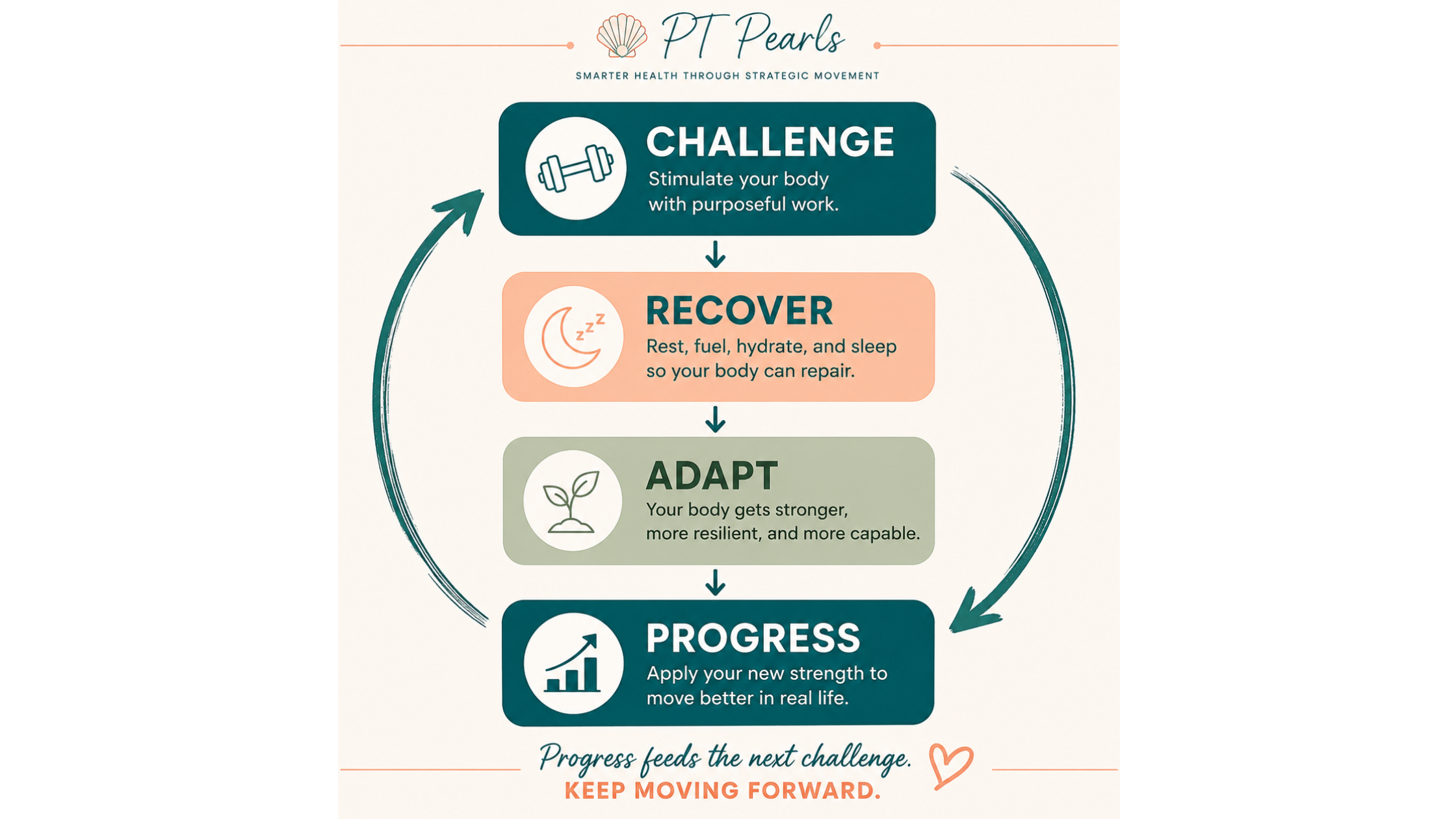
That cycle matters because we’re not trying to see how much punishment the body can tolerate. We’re trying to give it the right amount of stimulus to create a positive adaptation, allow it to recover, and then gradually ask for more.
That doesn’t mean strength training should never be uncomfortable. There’s a difference between muscle-use discomfort and pain that’s telling you something isn’t right. Challenging muscles can burn, fatigue, shake, and feel sore afterward. That can be part of conditioning.
Sharp or radiating pain, worsening symptoms, significant loss of form, or discomfort that starts changing how you function in everyday life is different. If you’re repeatedly so uncomfortable after training that you’re compensating, modifying work or recreational activities, or struggling to recover before your next session, don’t automatically assume the answer is to push harder.
Look at the whole equation. How much are you doing? How heavy is it? What does your form look like? How frequently are you training? Are you sleeping, hydrating, and fueling yourself adequately? Are you giving your body enough recovery to respond to the work?
Pain is one of the ways our bodies communicate. We need to learn how to listen to what it’s telling us.
Challenge enough to create change. Recover enough to allow change. Then progress what your body is ready to handle.
Aging Well Isn’t About Becoming a Bodybuilder
If you’re thinking, “Lori, I’m not trying to become muscular. I just want to age well,” I understand.
Aging well doesn’t mean your muscles have to look like a bodybuilder’s. But they do need enough strength, stability, power, and tone for your body type to support the life you want to live.
Some of that may look like traditional resistance training. A lot of it can also look much more like real life. You’re lengthening, controlling, decelerating, balancing, stabilizing, changing directions, and using multiple joints at the same time.
That’s what I mean when I say I want movement to look, smell, and taste more like real life.
And if becoming stronger also makes you look more toned, great. Let’s not pretend that isn’t a goal many of us have. Just remember that getting there involves more than one piece of the puzzle.
Training matters, but so does how you fuel your body. Hydration matters. Sleep and recovery matter. Consistency matters. Our systems are integrated, and when one area continually falls behind, it can affect what we’re trying to accomplish somewhere else.
You can’t pick one piece of the puzzle and expect it to carry the whole picture.
Start With What You Want to Keep
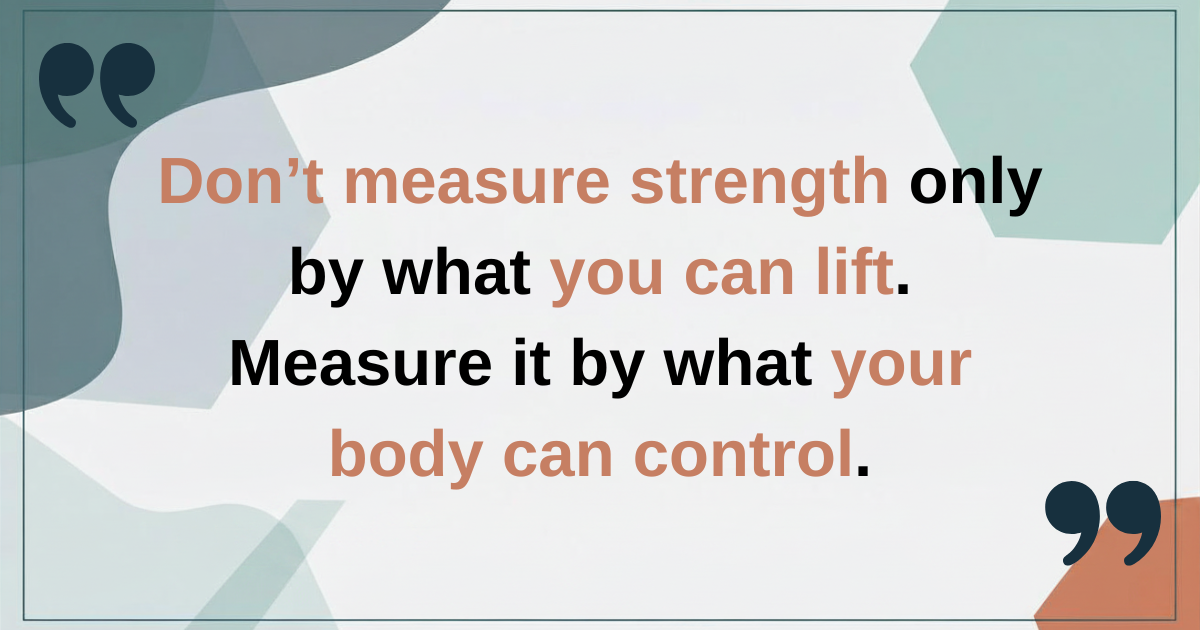
Instead of measuring your strength only by the number printed on a dumbbell, start looking at what your body allows you to do.
Can you get off the floor without fear? Can you comfortably climb stairs? Can you carry what you need to carry? Can you balance on one leg? Can you move quickly when the situation requires it? Can you lower, land, and stop yourself with control?
And maybe the most important question is this:
Can you still do the things you want to be doing 10 or 20 years from now?
That’s the kind of muscle I’m interested in helping you build.
Muscle that does something.
Ready to Put It Into Practice?
If you’d like a place to start, my free Seven Foundational Leg Patterns guide takes the squat we discussed in the last blog and builds outward into the different positions and demands your lower body needs for real life.
If you’re ready to take those patterns further, I’ve also created a companion video series. You’ll see me demonstrate all seven foundational movements, but the video goes beyond what’s included in the free guide. I’ve added bonus variations and 3D tweaks so you can see how changing position, direction, and other variables can turn one foundational movement into multiple ways to challenge your body.
That’s really the point of functional strength. We’re not collecting exercises. We’re giving your body more options.
Build muscle, absolutely. Just make sure you’re building muscle you can use.
To smarter health through strategic movement,
Lori
Your Movement Detective 🐚
P.S. Enjoyed this Pearl of Wisdom? Don't miss the next one! If this was forwarded to you,[click here] to subscribe so you get every new post sent directly to your inbox.
Research & Further Reading
Araújo CGS, et al. Muscle Power Versus Strength as a Predictor of Mortality in Middle-Aged and Older Men and Women. Mayo Clinic Proceedings. 2025. PubMed
Bogaerts A, et al. Impact of Whole-Body Vibration Training Versus Fitness Training on Muscle Strength and Muscle Mass in Older Men. Journal of Gerontology. 2007. PubMed
Simon AB, et al. The Clinical Utility of Whole Body Vibration: A Review of the Different Types and Dosing for Application in Metabolic Diseases. Journal of Clinical Medicine. 2024. PubMed Central (PMC)
As Seen In
Prevention: This 1 Exercise Combination Is Best for Longevity, According to Science. Lori is quoted discussing how muscle supports strength, stability, control, balance, and power in real life. Read Lori’s Prevention Feature


