Movement Resets & Movement Nutrition for Busy People | Pearls from a PT
If you read my first blog, “Your Desk Isn’t the Problem — Sitting Still Is,” you already know the big idea: sitting isn’t the enemy, but staying in one position for too long is.
This is where movement resets come in.
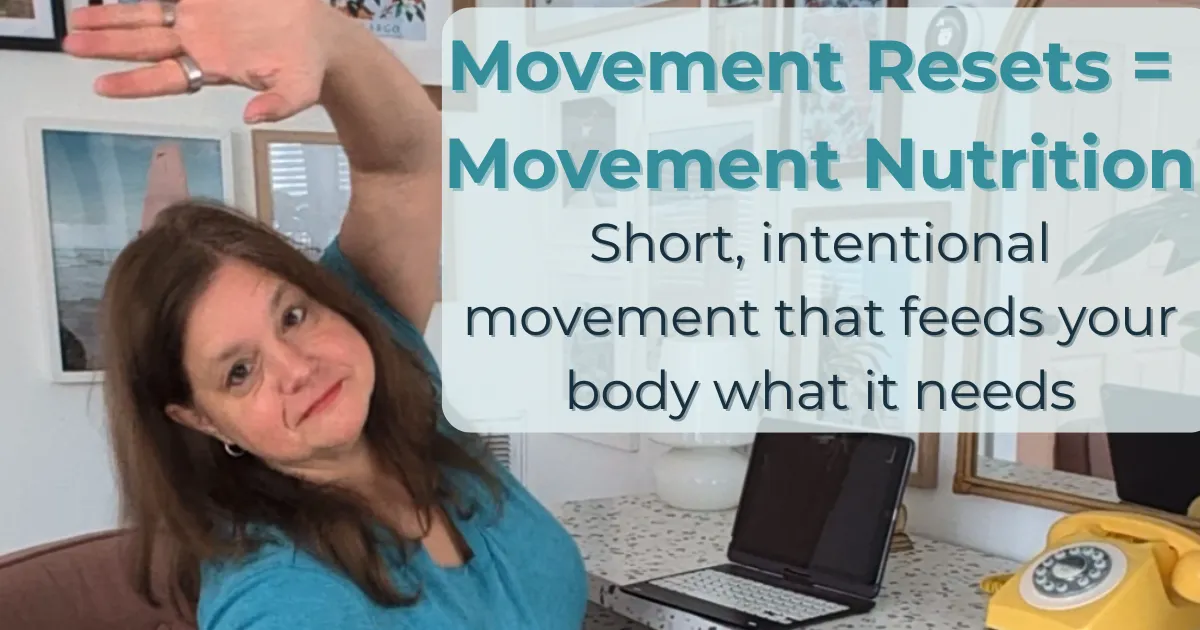
You might also hear them called movement breaks, movement snacks, or exercise snacks. Different names, same idea. I also love to call them movement nutrition because just like food fuels your body, these small, intentional movements give your joints, muscles, and nervous system exactly what they need to function better.
A movement reset, or movement nutrition, is an intentional, short burst of movement that interrupts stillness and feeds your body what it’s missing in that moment.
Not harder.
Not longer.
Just smarter.
And here’s something important I want to say clearly:
All movement counts. If all you can do is stand up, shift positions, or walk to the kitchen, that still matters. That’s already a win.
Movement resets aren’t about being perfect. They’re about being aware. When we add a little intention and direction to the movement we’re already doing, those minutes start working harder for us. That’s when movement becomes nourishment, not just motion.
That’s where the magic happens.
What Is a Movement Reset (or Movement Nutrition)?
A movement reset is a short, intentional, dynamic change in position designed to give your body what it needs right now. Think of it as movement nutrition for your joints, muscles, and nervous system.
Not what it needed yesterday.
Not what your friend needs.
Not what Instagram told you to do.
What your body is asking for in that moment.
Movement resets can:
support posture
restore mobility
wake up stability
boost energy and circulation
calm your nervous system
Sometimes you need one. Sometimes you need another. Sometimes you need a combination. Just like food, your body doesn’t need the same “nutrition” every time.
That’s why doing the same stretch every day doesn’t always work.
Your body changes.
Your stress changes.
Your workload changes.
Your sleep changes.
Your nervous system changes.
So your movement nutrition should change too.
And one important piece that makes movement resets so powerful is this:
Your body doesn’t move in straight lines. Every joint and muscle works in three directions—front to back, side to side, and rotation. And every movement you make is a chain reaction from head to toe.
When your resets include variety and direction, you’re not just “moving more.”
You’re reminding your body how it was designed to move.
That’s real nourishment.

Why Traditional Stretching Doesn’t Always Fix “Stiffness”
This is one of the biggest misunderstandings I see.
People feel stiff and assume:
“I need to stretch.”
Sometimes that’s true. But often stiffness is a sign of:
muscles working too hard
joints not being supported
stability being asleep
or posture being off
Stretching an overworked system without restoring support is like pulling on a loose thread in a sweater. Yes, the hanging thread disappears. It looks a little neater for a moment. But underneath, the fabric is actually starting to unravel.
You didn’t fix the structure of the sweater. You just changed how it looked.
In the body, tight muscles are often tight because they’re compensating for something else that isn’t doing its job. When you stretch what’s already overloaded, you may feel relief briefly, but you haven’t restored balance. That’s why the stiffness keeps coming back.
Movement resets, or movement nutrition, look at the whole picture: posture, mobility, stability, energy, recovery, and how the body connects in multiple directions.
That’s why they work when stretching alone doesn’t.

The 5 Types of Movement Resets (Your Movement Nutrition Menu)
Think of these as five forms of movement nutrition. You don’t need all of them every day. You just need the right one at the right time.
And remember: even a small reset is better than none.

1. Posture Resets
When you feel collapsed, compressed, or heavy.
These help redistribute load through your body so the same tissues aren’t doing all the work. They also reconnect your head, ribcage, and pelvis so your body feels stacked and supported again.
Examples:
Sitting tall and stacking ribs over pelvis
Gentle chin tuck
Shoulder roll with breath
What it feels like: Lighter. Taller. More supported.
Common mistake: Trying to “hold perfect posture” all day instead of resetting it briefly and often.
2. Mobility Resets
When you feel stiff, tight, or stuck.
These give joints permission to move in directions they haven’t used in a while. Especially important: adding side-to-side motion and rotation, not just forward and backward.
Examples:
Gentle rotation
Side bending
Reaching overhead and across
What it feels like: More fluid. Less restricted.
Common mistake: Only moving in one direction instead of restoring full 3D motion.
3. Stability Resets
When you feel weak, wobbly, or off.
These wake up the muscles that protect your joints and help your body feel organized again. They bring structure back into the system.
Examples:
Neck isometrics
Slow sit-to-stands
Balance work
What it feels like: Stronger. More grounded. More “together.”
Common mistake: Stretching when your body actually needs support.
4. Cardio / Metabolic Resets
When your energy, focus, or circulation dips.
These interrupt stillness with intensity and wake up your whole system.
Examples:
Brisk walking
Stairs
Marching in place
What it feels like: More alert. More energized.
Common mistake: Thinking cardio has to be long or sweaty to matter.
5. Recovery Resets
When you feel wired, overwhelmed, or tense.
These help your nervous system downshift and restore calm.
Examples:
Slow nasal breathing
Long exhales
Gentle shoulder or neck release
What it feels like: Calmer. More settled.
Common mistake: Ignoring recovery until burnout hits.
Want to See Real Examples?
If you’d like to see visual examples of each reset in real life, you can click the words below to go straight to my Instagram:

All Movement Counts (and Intention Turns It Into Movement Nutrition)
Standing up is movement.
Walking is movement.
Reaching is movement.
If that’s all you do today, that’s still valuable.
Movement resets simply help you make those movements more effective by adding:
awareness
direction
purpose
They turn everyday movement into movement nutrition by layering in variety, 3D motion, and connection.
It’s the difference between:
“moving because I had to”
and
“moving because my body asked for it.”
That’s a powerful shift.
Introducing: Reset Week
To make this practical and simple, I’m creating a 5-Day Movement Reset Week, or think of it as a 5-Day Movement Nutrition Plan for Your Body.
Each day we’ll focus on one type of reset:
Day 1: Mobility
Day 2: Stability
Day 3: Posture
Day 4: Cardio / Metabolic
Day 5: Recovery
Each reset will take 30–60 seconds. Nothing complicated. Nothing overwhelming. Just real-life movement you can use immediately.
This is a preview of how I teach inside the Disrupt Method: simple on the surface, powerful underneath.

Why This Matters for the Disrupt Method
The Disrupt Method is built for busy people who:
sit a lot
don’t have time for long workouts
want to feel better without doing more
Movement resets are the foundation. Movement nutrition is the language.
Disrupt just layers progression, personalization, and efficiency on top.
Think of Reset Week as the trailer.
The Disrupt Method is the full movie.
Where to Start
If you want to try this now:
Download the Move More Cheat Sheet
Follow along with Reset Week
If you want clarity on what your body needs most, start with the Movement Blind Spot Guide
And if this resonates, join the Disrupt Method Waitlist
Because movement doesn’t have to be harder.
It just needs to be smarter.
— Lori
Your Movement Detective


