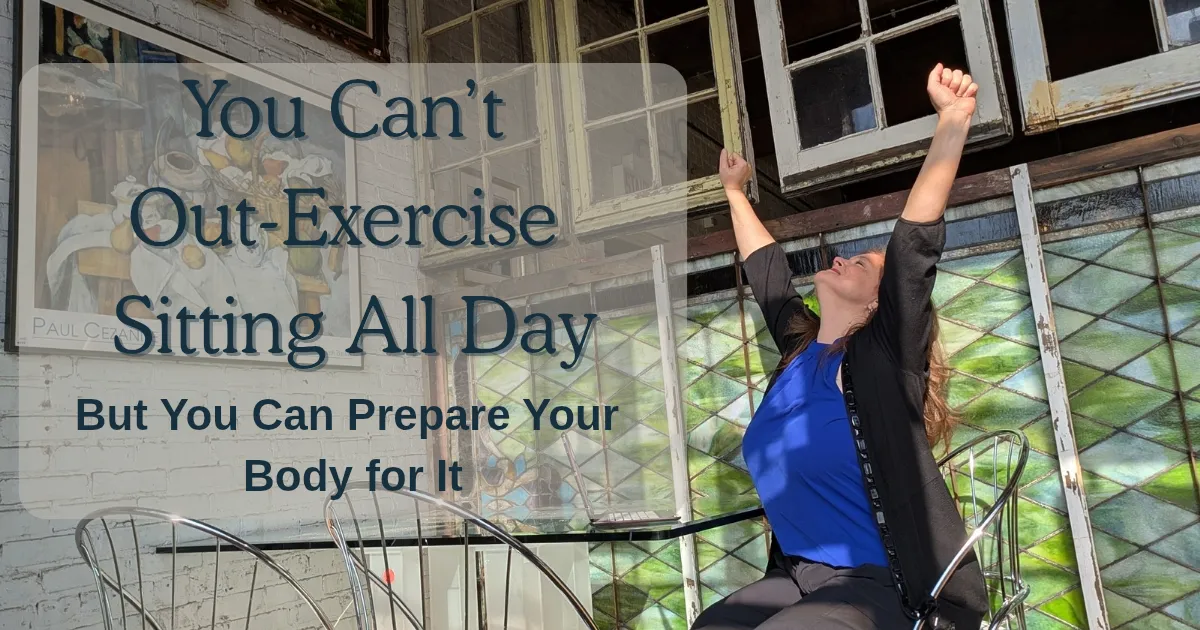
You Can’t Out-Exercise Sitting — But You Can Prepare Your Body for It
Why daily movement interrupts matter more than one long workout — especially for high-performing adults who sit.
The Pattern I See
There’s a pattern I see over and over again.
People sit most of the day. They work hard. They commute. They show up for their families.
Then they try to make up for it with one long, intense workout.
They’re not lazy. They’re not doing it wrong. They’re trying.
But the body doesn’t work that way.
You can’t out-exercise 8–10 hours of accumulated stillness.
Not because you’re weak. Because physiology adapts to input.
And prolonged stillness is powerful input.
The Cold Car Analogy

Here in Chicago, in the dead of winter, my car doesn’t like being rushed.
When it’s freezing cold:
the engine is stiff
the windows are iced
everything inside is sluggish
I can’t jump in and go from zero to sixty safely.
I have to warm it up first.
Your body works the same way.
When you sit for long stretches:
circulation slows
joints lose motion
stabilizers go quiet
posture collapses
your nervous system downshifts
That’s not aging.
That’s adaptation.
The 0 to 60 Problem
Now imagine asking that same system to perform at 80–90% effort.
Heavy lifts. High-intensity intervals. Aggressive cardio.
It doesn’t guarantee injury.
But it increases risk for:
muscle strain
joint irritation
lingering stiffness
delayed recovery
This is especially common in busy adults who sit most of the day — whether you're 30, 45, or 60.
One workout cannot undo a full day of sedentary load.
That’s not how physiology works.
Why One Minute Changes the Baseline
This is where short movement interrupts matter.
Research on Vigorous Intermittent Lifestyle Physical Activity (VILPA) shows that even one minute of intentional effort performed multiple times per day can significantly improve cardiometabolic health.
But beyond research, here’s what’s happening functionally:
Each minute:
increases circulation
activates stabilizers
restores joint motion
elevates heart rate
improves neural readiness
Think of it like adding a credit to your movement bank.
You’re not going from empty to full.
You’re raising your baseline.
Why I Teach Three Minutes

One minute opens the door. Three minutes allows integration.
In three minutes you can:
move in multiple planes
combine mobility and stability
elevate metabolism safely
create rhythm and coordination
Three minutes is still doable.
But it creates deeper physiological change without overwhelming your schedule.
This isn’t about replacing workouts.
It’s about preparing for them.
The Better Model
Instead of:
Sedentary baseline → aggressive spike
Shift to:
Active baseline → prepared output
Layer short movement interrupts throughout your day.
Arrive at your workout warm. Leave your workout resilient. Finish your day with capacity left.
That’s preparation.
Not punishment.
Conclusion
You don’t need to abandon intensity.
You need to earn it.
Not by grinding harder.
By staying online throughout the day.
Small inputs. Layered consistently. Strategic interruptions.
That’s how high-performing adults protect longevity.
If you want a structured 3-minute system designed specifically for busy people who sit, join the waitlist for Sit Safer. Move More. — The DISRUPT Method.
Because your body doesn’t need more punishment.
It needs smarter preparation.


