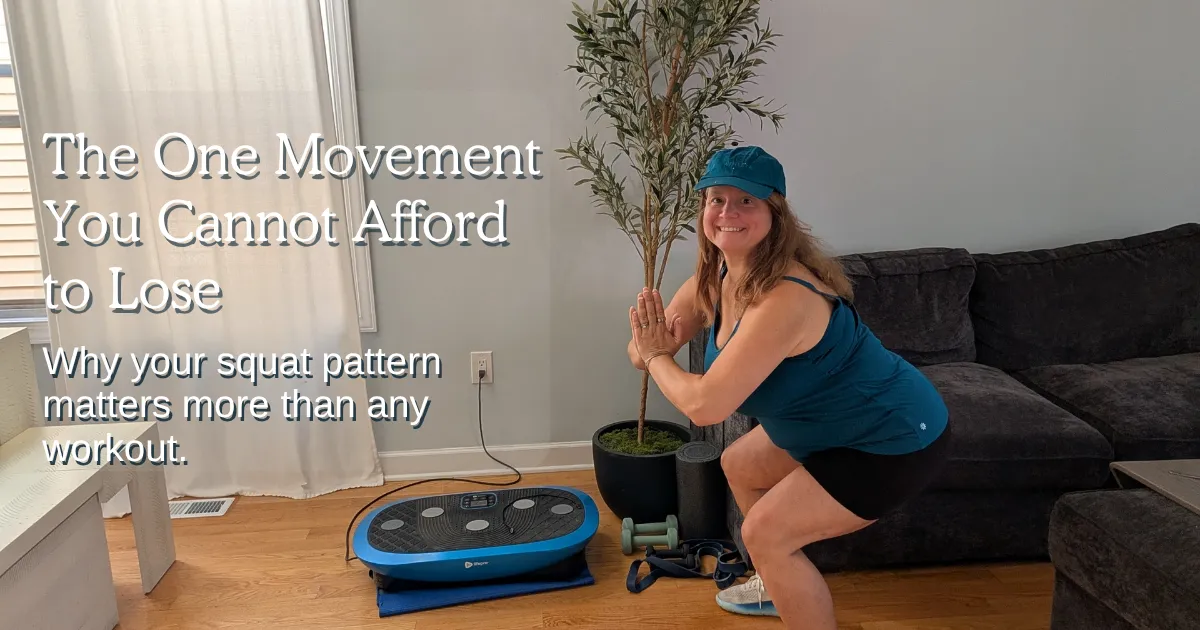
The One Movement You Cannot Afford to Lose | Functional Strength After 50
This post may contain affiliate links. If you purchase through one of these links, I may earn a small commission at no extra cost to you.
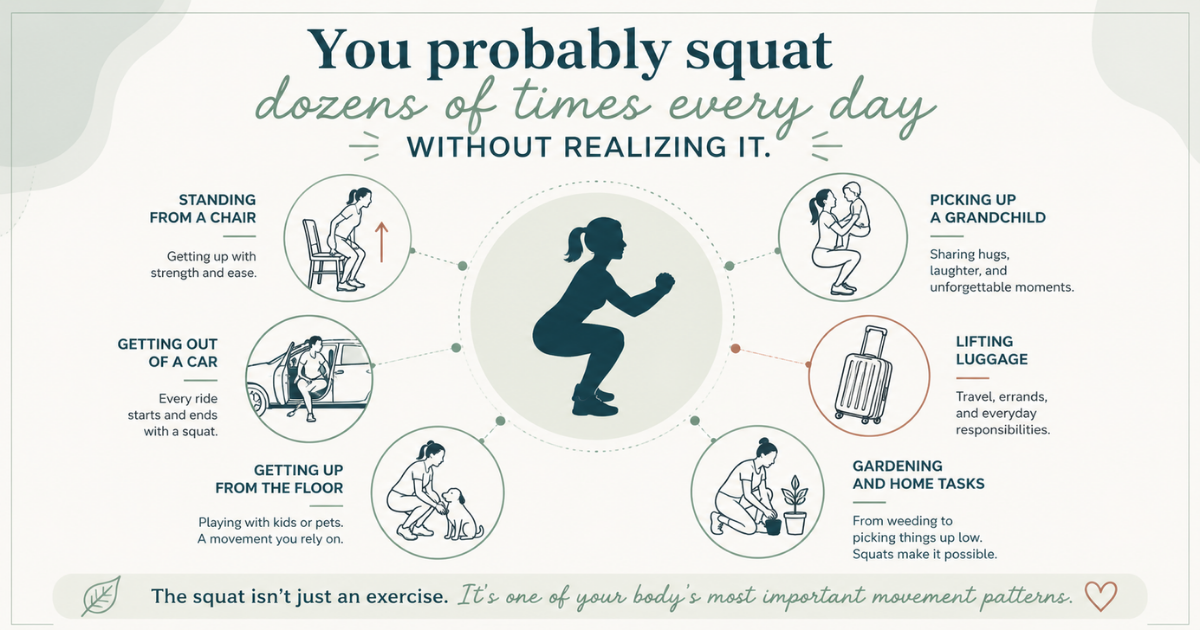
Think about the last time you stood up from a chair without thinking about it. Or got off the floor after playing with a kid or a pet. Or climbed out of a low car seat. None of that felt like exercise. It just felt like living your life.
But every single one of those moments is the same movement pattern. It is a squat. And whether you have ever set foot in a gym or not, your ability to do that movement well is one of the biggest predictors of how independent, safe, and strong you stay as you get older.
The Test That Says More Than Any Scale
Researchers use something called the sit to stand test to measure functional strength in adults. It is exactly what it sounds like. You sit in a chair, you stand up, you sit back down, and you repeat it as many times as you can in a set amount of time, or you time how long it takes to do it a set number of times.
It sounds almost too simple to matter. But this test is used in clinics and research settings because it correlates with things that matter far more than how you look in a mirror. A large study out of the Toledo Study for Healthy Aging followed nearly 1,900 older adults and found that people with weaker sit to stand power had a significantly higher risk of dying over the following nine years, along with higher rates of falls, fractures, and hospital stays. The sit to stand exercise is not just something researchers use in a lab. It is one of the simplest ways to check your own functional strength at home, and a movement most people do without a second thought turns out to be one of the clearest windows we have into how well your body is actually functioning.
That is the squat. Not the version with a barbell across your shoulders. The everyday version you already do dozens of times a day without noticing.
What I See In The Clinic
One of the patients who has stuck with me the most was a gentleman in his mid nineties who could barely walk and could not get out of a chair without help. We started with blood flow restriction bands and sit to stand practice right there in the clinic. He got his own set of bands for home and did sit to stands every single day. Six weeks later he was getting out of his chair on his own and walking independently and safely.
That is not a story about an intense workout program. It is a story about one functional movement, practiced consistently, giving someone their independence back.
My Training Looks a Little Different
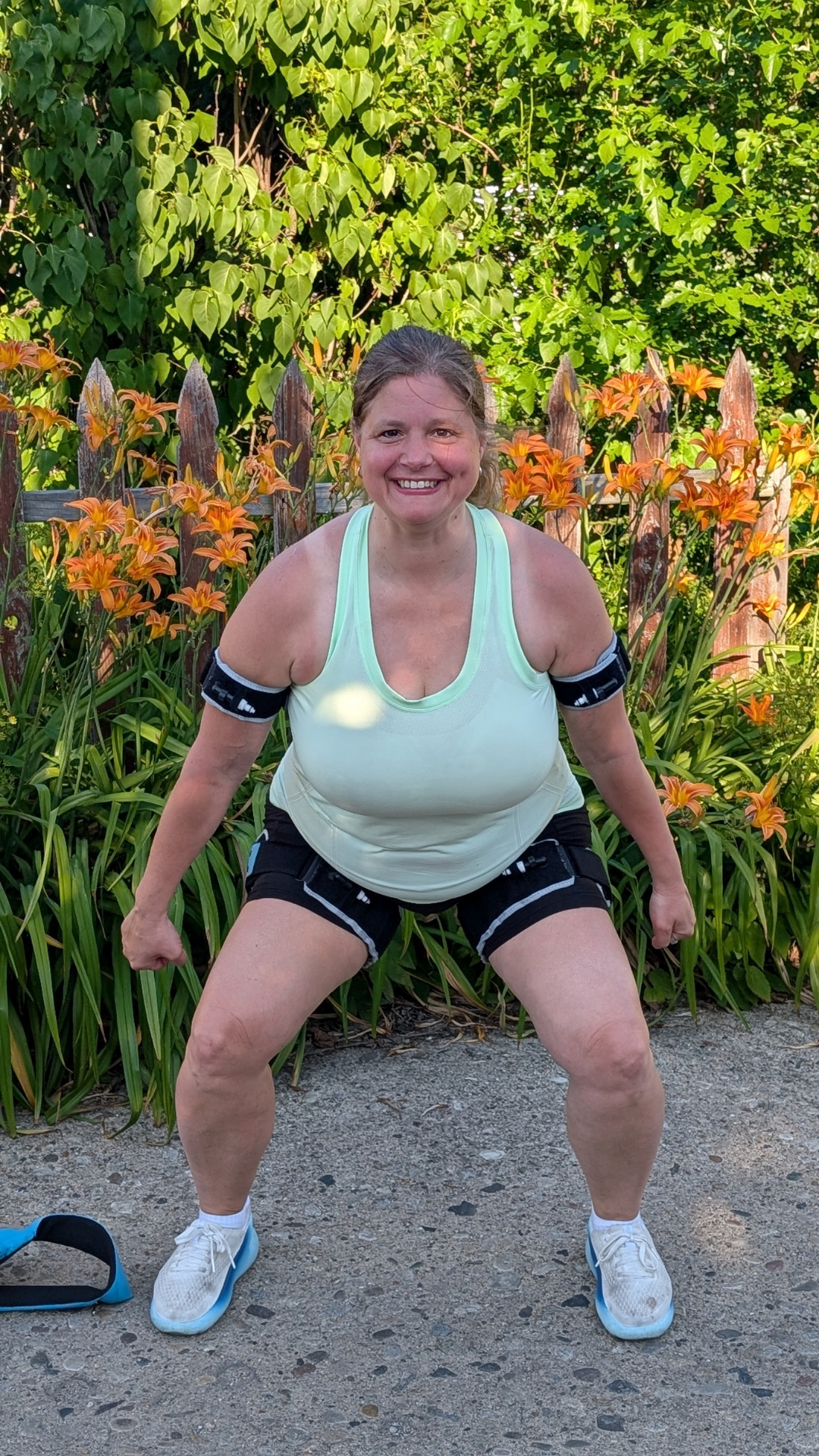
One tool I use in the clinic and in my own training is Blood Flow Restriction, or BFR. You absolutely do not need BFR to build stronger legs. I use it because it helps me work smarter, not just harder. With a busy schedule and joints that do not always love heavy lifting, BFR lets me create a meaningful training stimulus using lighter loads in less time. That is a win for me because it makes staying consistent much easier, and consistency is what really moves the needle.
PT Pearl 💚
Activity: Practice your sit to stands and squats in a range you can control.
Strategy: Progress the range and the load gradually, and train in more than one direction.
Optional Tool: Blood Flow Restriction bands can increase the training effect using lighter loads, if you decide to add one.
Curious about BFR? Learn more about the research behind it and save $50 on the B3 bands I use.
Whether you use a tool like BFR or not, the foundation is still the same. Own the movement first. Then decide if adding strategy or tools makes sense for your goals.
The Knee Pain Trap
A lot of people avoid squatting because their knees hurt, and they assume that means squatting is bad for them. I understand why that feels logical. But arthritic joints actually do better with regular movement and appropriate load, not with sitting still and avoiding it altogether. Inactivity tends to make joint pain worse over time, not better.
You do not need a perfect, pain free, full depth squat to get the benefit. Finding your happy range, even a small modified range, and working within it consistently is far more valuable than giving up on the movement entirely.
PT Pearl 💚
Tight calves or stiff ankles limiting your squat? Try slightly elevating your heels. It reduces the ankle mobility needed and may help you squat deeper and more comfortably. Start with a small lift and work within a range that feels good.
Want to learn more? I shared my PT perspective on heel-elevated squats, including how they can change ankle, knee and back demands, with Fit&Well.
Two Entry Points, Not Two Different Movements
This is where I want to clear up some confusion. A sit to stand and a free standing squat are not competing exercises. They are two points on the same continuum, and knowing which one belongs in your routine right now is exactly the kind of Test, Don't Guess thinking I want you walking away with.
A sit to stand uses a chair, box, or bench to control how deep you go. That built in stop point makes it the safer, more controlled place to start if you are managing joint pain, rebuilding strength after time off, or working on fall prevention. It also does a great job teaching your hips to hinge correctly and your glutes to actually fire, which is the foundation everything else gets built on.
A free standing squat removes that safety net. It asks more of your balance, your ankle mobility, and your core, and in exchange it gives you a bigger range of motion and a bigger overall training effect. That makes it the natural next step once the sit to stand feels easy and controlled, not necessarily the place everyone needs to start.
Neither version is the wrong answer. The right answer is whichever one matches where your body is today.
Why This Fits the Test, Don't Guess Philosophy
I talk a lot about precision over volume and working smarter, not harder. The squat is the perfect example of why that matters. You do not need to guess whether this movement pattern deserves your attention. The research already answered that question, which is the whole point of Test, Don't Guess. Strong hips, strong quads, and a squat pattern your body can trust are not optional extras for later. They are the foundation everything else gets built on, especially once you hit midlife and your body starts asking for a different kind of maintenance than it used to.
This connects directly to something I have been living out loud through my own body recomposition experiment this year. Strength training has consistently been the piece that moves the needle the most, not just for how my numbers look on a scale but for how capable my body feels day to day. If you want the full data behind that, I broke down six weeks of real numbers in "Body Recomposition After 50".
The Blind Spot Most People Have
Here is where most people miss it. They think of the squat as one single movement done one single way. But your body needs to be able to squat well in more than one direction. Straight ahead is not the only pattern life asks of you. You twist while you lower into a car seat. You shift your weight to one side reaching for something low on a shelf. You catch yourself off balance stepping off a curb.
If you only ever train or think about the squat in one plane of motion, you are leaving gaps that show up exactly when you need stability the most. This is the same whole body, connected system thinking I walked through in "The Story Behind Everything I Teach", where I explain why isolating one part of the body rarely solves the problem you are actually dealing with.
One Thing You Can Do Today
Try your own mini sit-to-stand test. Stand up from a chair five times without using your hands. Notice how it feels. Controlled and easy, or slower and more effortful than you expected? That single check tells you more about where to start than any generic workout plan could.
If it felt harder than you expected, you are not alone, and you are also not stuck. I put together a free guide with seven functional lower body moves designed to build exactly this kind of strength, and how to layer in different directions of motion so your body is prepared for more than just straight ahead squats. This is the same three tier movement framework I introduced in "Same Body. Busier Life", applied specifically to your legs and hips. Activities build the foundation. Strategy helps you progress. Tools can help fill the gaps when they are the right fit for you.
Click here to get your free copy of the 7 Functional Leg Moves Guide
Want to see the movements in action — and take them further?
The full 7 Foundational Leg Patterns video program brings all seven patterns to life with step-by-step coaching, plus additional 3D tweaks, variations and bonus ideas you won't find in the free guide. You'll see how changing direction, position and movement can turn familiar exercises into something much more useful for real life.
See it. Try it. Own it. — $19.99
Optional Tools That Can Help
You don't need special equipment to build stronger legs. These are simply tools I personally use to add variety, increase the training effect, or make strength training fit different situations.
- B3 Blood Flow Restriction Bands — my favorite tool for building strength with lighter loads
- LifePro Rumblex Plus Vibration Plate — my go-to for warm-ups, recovery, and extra strength work
- Yes4All Weighted Vest — an easy way to add challenge to everyday movement
PT Pearl 💚
You don't need the perfect exercise. You need a movement your body will still thank you for 20 years from now. For most people, that starts with learning how to squat well.
Your legs carry you through every single day. They deserve more than an afterthought.
Want more? Enter your email here to get new posts, program updates, and movement pearls delivered straight to your inbox.
Lori Diamos MS, PT, FAFS
Physical Therapist and Founder of PT Pearls
@pearlsfromapt
🐚 Lori, Your Movement Detective


