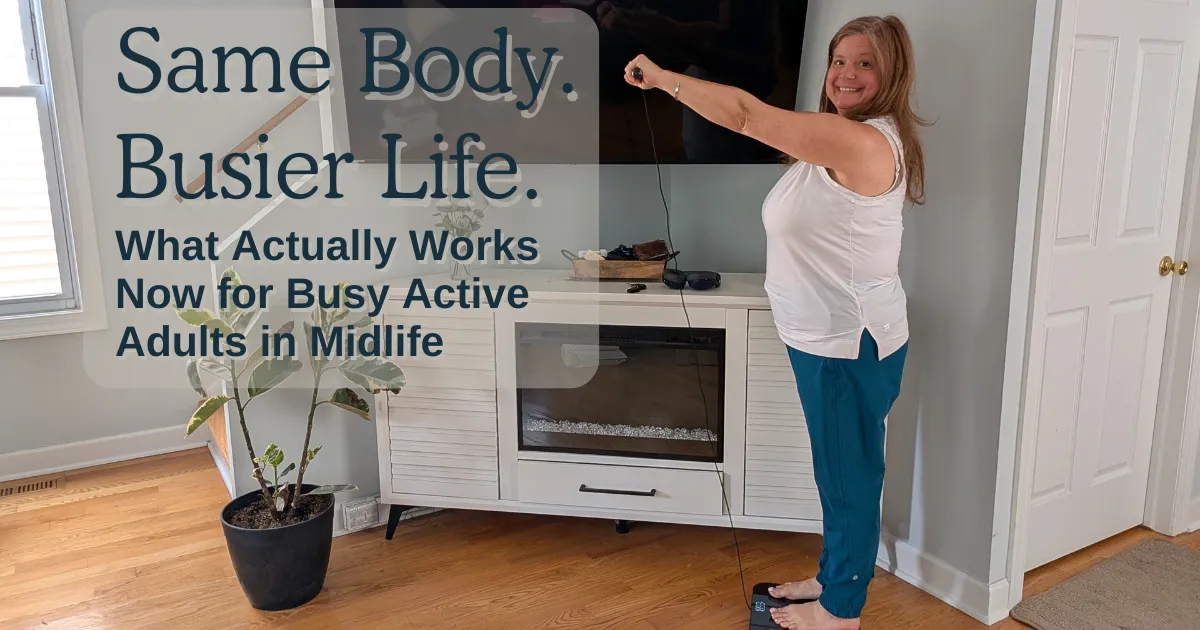
Same Body. Busier Life. Here's What Actually Works Now.
Your Body Isn't Breaking Down. It's Sending You a Message.
Affiliate disclosure: This post contains affiliate links. If you choose to purchase through my links I may earn a small commission at no additional cost to you. I only share products I personally use and believe in.
You might call it meno belly. Beer belly. Dad bod. Spare tire. Doctors call it visceral fat. And in midlife it is something almost all of us are navigating whether we talk about it out loud or not.
Confession. I am a physical therapist with 30 years of experience. I know the research. I own the tools. And my midlife hormones are doing whatever they want anyway. My own body is humbling me right now.
This fat did not used to be on my radar. Now it is one of the numbers I watch most closely and it shifted faster than I expected. I am currently at the heaviest I have ever been in my entire life. Not because I stopped caring. Not because I stopped moving. My body changed the rules and I had to change my strategy.
It started in August of 2020. I got COVID and literally could not move for two weeks. I have never been that sore in my life. What followed were years of long haul symptoms that I now believe morphed into perimenopause and were further complicated when I discovered I carry a gene mutation called MTHFR. I know, the abbreviation looks like something else entirely. What it actually means is that my body's detox pathways do not work as efficiently as they should. Toxins and chemicals can build up faster than in someone without the mutation. Most people who have it do not even know. I only found out because I went looking for answers when conventional medicine could not explain what was happening to me.
My functional medicine neighbor helped connect the dots. The viral response from COVID likely activated that gene, and now any significant stressor, illness, heat, or life overwhelm can trigger a full body regression.
I had a horrific case of the flu in December. I was not myself for over a month. And just like that, rapid weight gain again.
I share this not for sympathy. I share it because if you are a busy active person in midlife who is doing a lot of the right things and still feeling like your body is working against you, I want you to know you are not imagining it. And you are not alone.
Your body is not breaking down. It is sending you a message. The question is whether you have the right strategy to respond.
What is actually happening in there
After 30, muscle mass begins declining in a process called sarcopenia. That loss accelerates with age. By our 50s many of us are also managing peak career demands, caregiving responsibilities, family stress, and increasingly sedentary days, all with less available time and often more joint limitations than we used to have.
Muscle tissue is metabolically active. It helps the body use energy efficiently and supports blood sugar regulation. As muscle decreases and visceral fat increases, the risk for inflammation, insulin resistance, and cardiometabolic issues goes up.
The research is pretty clear on what helps. Cardiovascular activity, especially with some intensity mixed in, combined with strength training. You need to build muscle because it is metabolically active and you need to elevate your heart rate. They complement each other. The American Heart Association guidelines are 150 minutes of moderate intensity cardio per week and strength training at least two days a week. Most people are struggling to meet even one of those targets. The three tier system below is how I am working toward both without overhauling my life.
Hormones shift. Recovery slows. Exercises that felt fine two years ago now flare things up. You pull something doing something you have done a hundred times. You wake up stiff in ways that feel new and confusing.
This is not failure. This is physiology. And it responds to the right inputs.
The mistake most people make at this stage
They either push harder doing what used to work, or they pull back and do less. Both miss the point.
More is not always better especially after 50. Punishing workouts do not address visceral fat more effectively than strategic consistent movement. They often just increase inflammation and slow recovery further.
The answer is not more effort. It is smarter inputs matched to the body you have right now.
And here is the mindset shift that changes everything. This is about addition not subtraction. You still want your yoga class. You still want your weekend walk with friends. You still want your pickleball game. Keep all of it. Every bit of it counts.
But stop letting the hours in between be dead time. Out-Exercise Sitting.
Three minutes done consistently beats sixty minutes done occasionally
The reason the BMC study worked isn't complicated. Consistency at a low barrier wins over intensity at a high barrier. Every time. This is the core of the Disrupt Stillness Method.
When movement is woven into what you're already doing, it stops being a decision you have to make. It becomes part of the day. And that accumulation, done daily across multiple small windows, adds up to something real.
Your circulation improves. Your metabolism stays more active throughout the day. Your energy doesn't crater at 3pm. Your body doesn't arrive at evening stiff and locked up from hours of stillness.
You start to feel different. Not because you did more. Because you did it smarter.
Three tiers that work on every kind of day
I do not have a perfect schedule. Nobody does. What I have is a flexible system that works on the full days, the half days, and the days where life takes over completely.
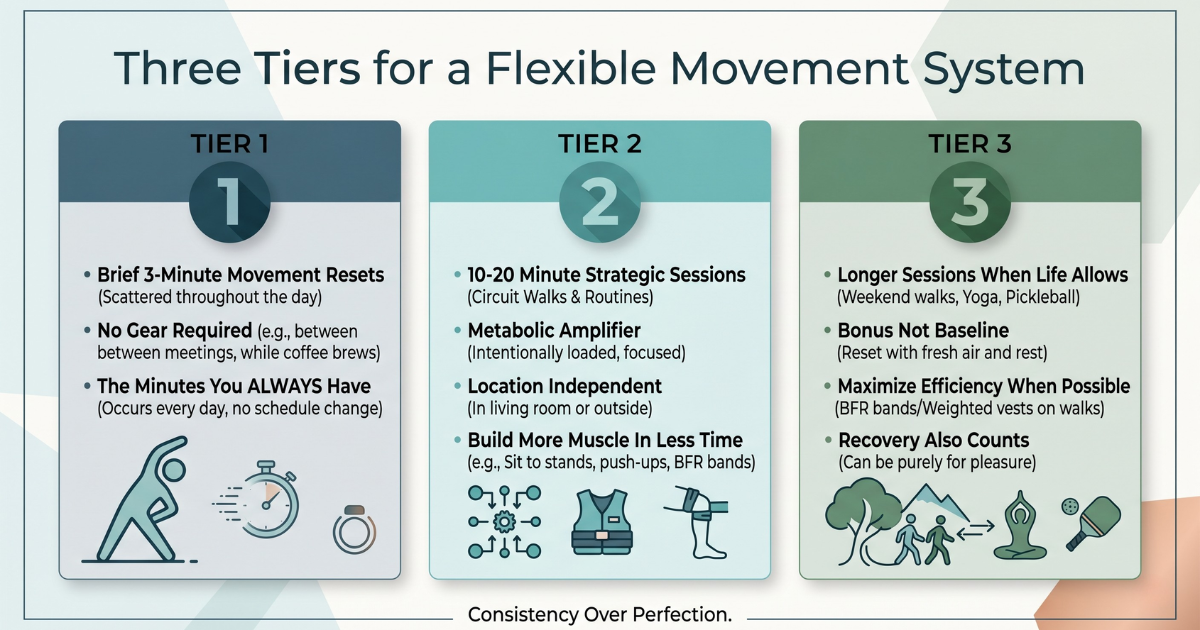
Tier 1 — The minutes you always have
These are your 3-minute movement resets scattered throughout the day. Between meetings, while coffee brews, after a long drive, at the end of the workday. No gear required. No schedule change needed.
I use my Oura ring as my personal accountability check. My goal is to get through the day without a movement alert, or at most one or two. It keeps me honest about how much stillness is actually accumulating between my intentional movement windows. You do not need an Oura ring to do this. You just need to start noticing.
Research on micro exercise breaks shows that even brief hourly movement can improve blood sugar, blood pressure, and waist circumference over 12 weeks with over 80% of people sticking with it. This is actually the same research I referenced when Vogue reached out to me recently for a piece on micro workouts. If mainstream press is covering the science of movement snacks, the message is getting out.
Tier 1 happens every day no matter what.
Tier 2 — The 10 to 20 minutes when you have a little more
This is where I get strategic. I am building what I call circuit walks and circuit routines. Short, intentional, and loaded with purpose. When Chicago weather cooperates I take it outside. When it does not, I do it in my living room. The location does not matter. The intention does.
A typical session is 6 to 20 minutes. Get in, get the burn, get out, get back to life. One day I combined a weighted vest with bodyweight upper and lower body moves. The next day I added cardio bursts, more leg dominant, more impact. I almost always have my BFR bands on for these. They help me build more muscle activation and metabolic demand in less time, which matters when you are working against sarcopenia and trying to do it efficiently.
Simple moves like sit to stands targeting the large muscles of the legs and hips, wall or desk push-ups for upper body and core, and short cardio bursts like brisk walking intervals or stair climbing make up the bulk of it. Research on VILPA, vigorous intermittent lifestyle physical activity, shows that even one minute of vigorous activity performed several times throughout the day is associated with significant metabolic and cardiovascular health benefits.
Tier 2 is your metabolic amplifier. It does not replace longer workouts. It fills the gap when they do not happen.
Tier 3 — The longer sessions when life allows
Weekend walks with friends. A yoga class. Pickleball. A longer bike ride. These are the bonus not the baseline.
Most days when I walk I wear my BFR bands. Sometimes I add a weighted vest on top for a double metabolic effect. My walking friends often do the same and we get the benefits without adding a single minute to our time together. On recovery days I walk simply for the pleasure of it. No bands, no vest, just movement, fresh air, and the kind of rest that still counts as a reset. Recovery is one of our movement types for a reason.
When Tier 3 happens it is great. When it does not, Tier 1 and Tier 2 have already done their work.
The tools that help you get more from less
I want to be clear about something. I share these tools because I use them, I have seen them work clinically and personally, and I genuinely believe they are worth knowing about. Some links below are affiliate links. I only share things I believe in.
B3 Sciences BFR Bands
Blood flow restriction training uses partial occlusion to create a metabolic and muscle-building response with significantly lower loads. This matters after 50 because you get the strength and conditioning benefits without the joint stress. Research supports BFR for building and preserving muscle mass, improving blood sugar, supporting bone health, boosting growth hormone, and improving aerobic capacity. I am a certified BFR coach and these bands go with me almost everywhere, on walks, during circuits, and on the vibration plate.
Not sure if BFR is right for you? B3 Sciences has put together an extensive research page and an Is BFR For Me quiz worth exploring. I also put together my own BFR Starter Kit with links to the research, the quiz, tips I personally use, and things I have found most helpful as a certified BFR coach. You can grab it free under Resources at pearlsfromapt.com.
One more thing worth knowing. Through my personal affiliate link you can get $50 off the bands, a discount you would not get going directly to B3 Sciences. I share this because the bands are a real investment and if that discount helps someone actually get started, that matters more to me than the commission.
LifePro Rumblex Plus Vibration Plate
A 5 to 10 minute session activates more muscle fibers, supports circulation and lymphatic drainage, aids recovery, and emerging research suggests it may support reductions in visceral fat. It has become one of my favorite low-effort high-return tools especially on days when my body needs movement but not intensity. I am currently using it as part of my own personal experiment and will be sharing results as I go.
Hume Health Scale
I track more than weight. This scale breaks down body fat percentage, muscle mass, hydration, and metabolic trends so I can see what is actually changing versus what just feels different. It is how I am monitoring my own experiment honestly.
The experiment I just started
Six days ago I started tracking this intentionally. BFR training, whole body vibration, daily movement resets, strategic circuit walks, and monitoring everything with my Hume Health scale.
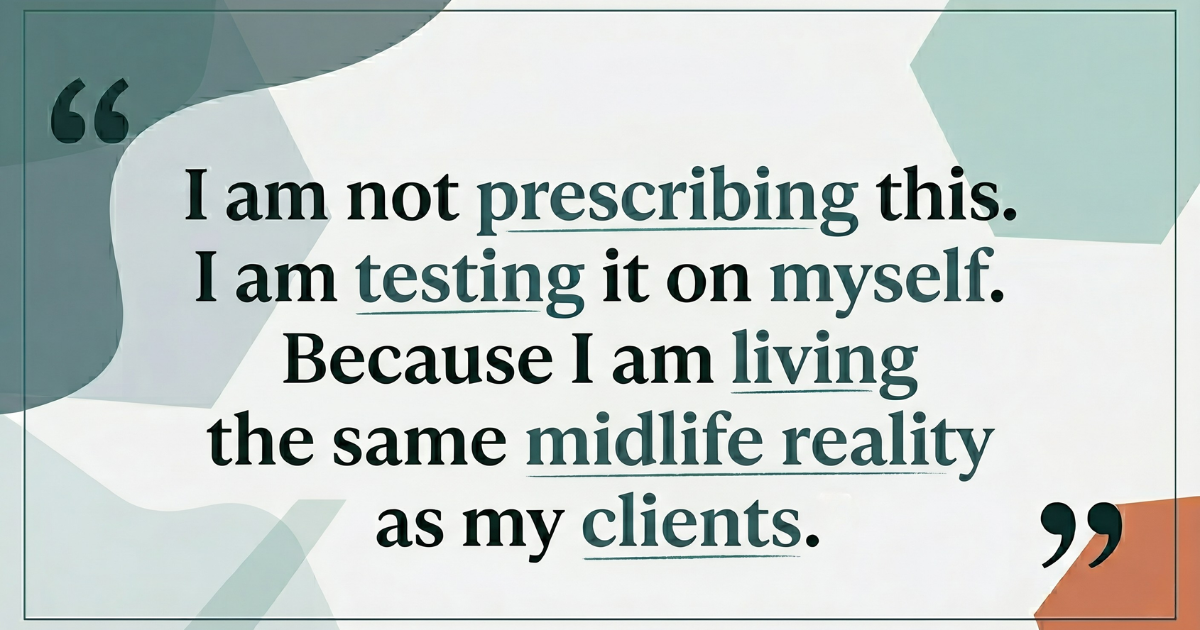
I am not prescribing this. I am testing it on myself and sharing what I find. Because I think that is what honest health guidance looks like right now. Not a protocol handed down from a position of authority. A PT who is living the same midlife reality as her clients, using the tools she teaches, and being real about the results.
I will share updates as I go. Stay tuned.
Where to start if this resonates
You do not need to overhaul anything. Pick one tier. Start there.
If you want your daily movement already structured and organized so you are not guessing, the Sit Safer Move More program was built exactly for that.
If you want to understand your own biology before adding anything else, the free IDLife Health Assessment is a great place to start. It takes about 10 minutes and gives you a personalized health score with research-backed lifestyle recommendations. The bigger value is what it does for your supplementation. Most people waste money on supplements that are trendy or that worked for someone else. This assessment cross-references your complete health history with the research and tells you what your body actually needs and what it does not. It flags anything that could be contraindicated based on your health history. If you already have supplements you love, use it as a check and balance. If you need a place to start, IDLife offers clean bioavailable options you can explore directly. Either way you stop guessing and start getting specific.
And if you want to go deeper, the IDLife DNA test uncovers how your body processes carbs, fats, and vitamins, how you are wired to recover, and what your genetic blueprint actually suggests for your personal health strategy. It also gives you a fitness roadmap showing how you burn fat and how your body best responds to different types of movement and exercise so you can stop guessing and start training for your actual genetic code. It is what changed everything for me when conventional medicine ran out of answers.
Stop guessing. Start testing.
To smarter health through strategic movement,
Lori
Your Movement Detective
P.S. Enjoyed this Pearl of Wisdom? Don't miss the next one! If this was forwarded to you, [click here] to subscribe so you get every new post sent directly to your inbox.
Source:
Want to dig deeper?
Here are independent, peer-reviewed studies behind what I shared in this post. These are listed separately from the B3 Sciences page so you can see the research on BFR comes from universities and journals, not just the brand itself.


