
Your Workout Isn't Competing With Laziness. It's Competing With Your Life
Be honest. When you think "workout" or "fitness," what immediately comes to mind?
For most people, it's some type of 45- to 60-plus-minute structured event, because that's what traditional fitness through a gym has looked like. But as a physical therapist of 30 years, I'm here to tell you that all movement matters, and when done regularly, even in just minutes at a time, it all starts to add up.
I work for somebody else 30 hours a week. I'm a wife and mom, and in my spare time I'm using my 30 years of experience to also build something of my own that helps people. Between work, family life, friends, having a personal life, extended family and all the day-to-day responsibilities that entails, there isn't always a lot of extra time or energy for traditional 45- to 60-minute workouts on a day-to-day basis.
Two of my workdays are essentially 10-hour days once you include paperwork and commuting. Some days even 10 minutes feels like a stretch. On those days, the answer isn't forcing a workout in anyway, since sometimes the smarter choice is doing less, or doing nothing, and not treating that as failure.
But those days are the exception. Most days, if I'm honest with myself, I can usually find five or six minutes somewhere. That's why I appreciate tools, strategies and programs that help me get more out of the minutes I have without necessarily sacrificing the training stimulus I'm trying to create.
Your workout isn't competing with laziness.
It's competing with your life.

Why BFR Became Personal for Me
My relationship with blood flow restriction training, or BFR, didn't start because I was looking for a fitness shortcut. It started after COVID.
I had COVID in August 2020 and developed long-haul symptoms afterward. Within about three months, I had gained roughly 15 pounds even though I hadn't dramatically changed what I was doing. My sleep became erratic, my mood was all over the place, my joints ached, and higher-intensity activity that I had previously tolerated became much harder.
Around that time, I found two tools that changed the way I thought about exercise when your body can't tolerate what it used to: blood flow restriction and vibration training. I became B3 Sciences certified in 2021, and I also received additional BFR training through B-Strong at a past employer.
BFR became incredibly useful for me because I could create a meaningful training stimulus using lighter loads and shorter bouts at a time when pushing harder simply wasn't working for my body. Since then, I've used it personally and clinically in many different ways, on walks, during short circuits, and with strength exercises. Clinically, I've used blood flow restriction with people ranging from high-school athletes to a patient in her 90s, and that range is part of what continues to interest me about it. BFR isn't one workout. It's a tool I can apply in a lot of different ways.
Affiliate disclosure: I am B3 Sciences certified and an affiliate. If you purchase B3 Bands through my link, I may earn a commission at no additional cost to you. I only recommend tools I personally use and believe can be useful when they are appropriate for the individual.
So What Does BFR Actually Do?
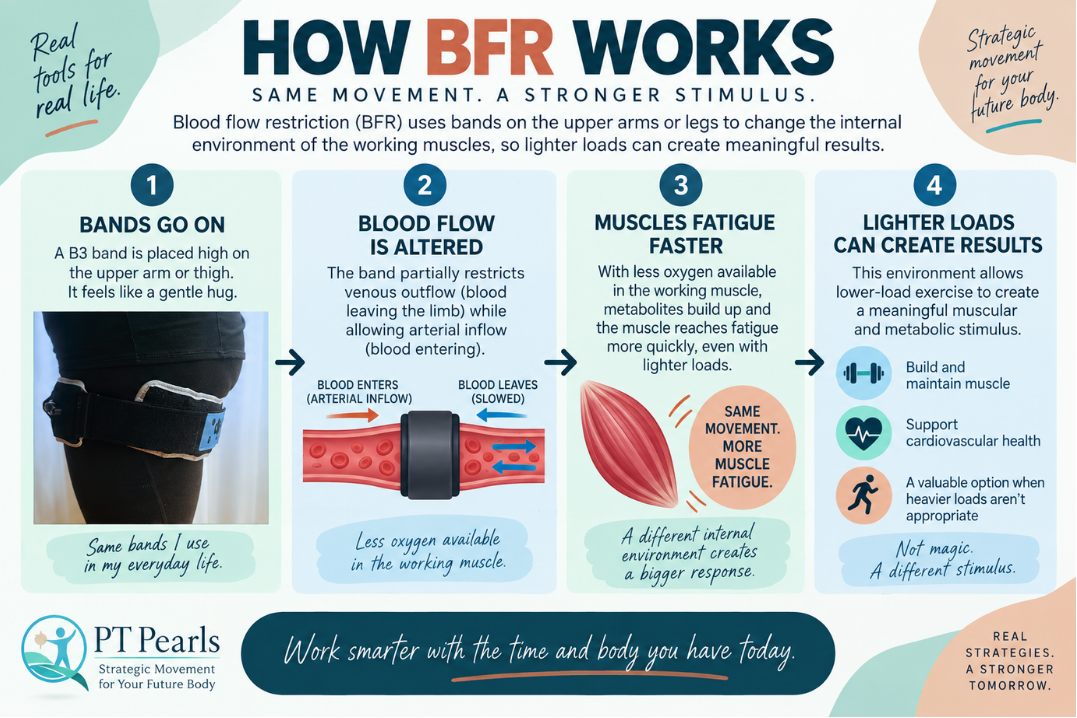
When I explain BFR to patients, I usually tell them I'm going to put a cuff or band high on their arms, legs or both, and it's going to give them a firm hug.
It changes blood flow in the working limb by restricting venous outflow while still allowing arterial inflow to varying degrees. That changes the internal environment of the muscle, so metabolites accumulate more quickly and the muscles fatigue faster, even though the external load can remain relatively light. In practical terms, that means I can challenge muscle without always needing a heavy dumbbell, barbell or machine, and that becomes especially useful in midlife.
Why Lighter Loads Matter More Than You Might Think
We need muscle as we age. That isn't negotiable. Muscle supports strength, mobility, metabolic health and our ability to keep doing the things we want to do. But maintaining muscle doesn't mean every training session has to involve heavy loads.
Research in older adults has found that low-load resistance exercise combined with BFR can produce greater strength and muscle improvements than low-load exercise alone. Research also suggests that BFR can produce muscle growth comparable to traditional higher-load resistance training in some settings, although heavier resistance training often remains better for maximizing pure strength.
That distinction matters because I'm not telling you BFR makes heavier strength training unnecessary. I'm saying it gives us another way to challenge muscle when heavier loading isn't appropriate, tolerated or realistic that day. That can matter when joints hurt, during certain stages of rehabilitation, when recovering from illness or injury, or simply when we need another way to keep challenging muscle as we get older.
Researchers are also beginning to look beyond muscle. Emerging studies are examining BFR's potential effects on brain health and neuroplasticity, including changes in BDNF, a protein involved in supporting the brain's ability to adapt and form new connections. The research is promising, but still early, and it's an area I'll be watching closely.
Gap Filler or Accelerator?
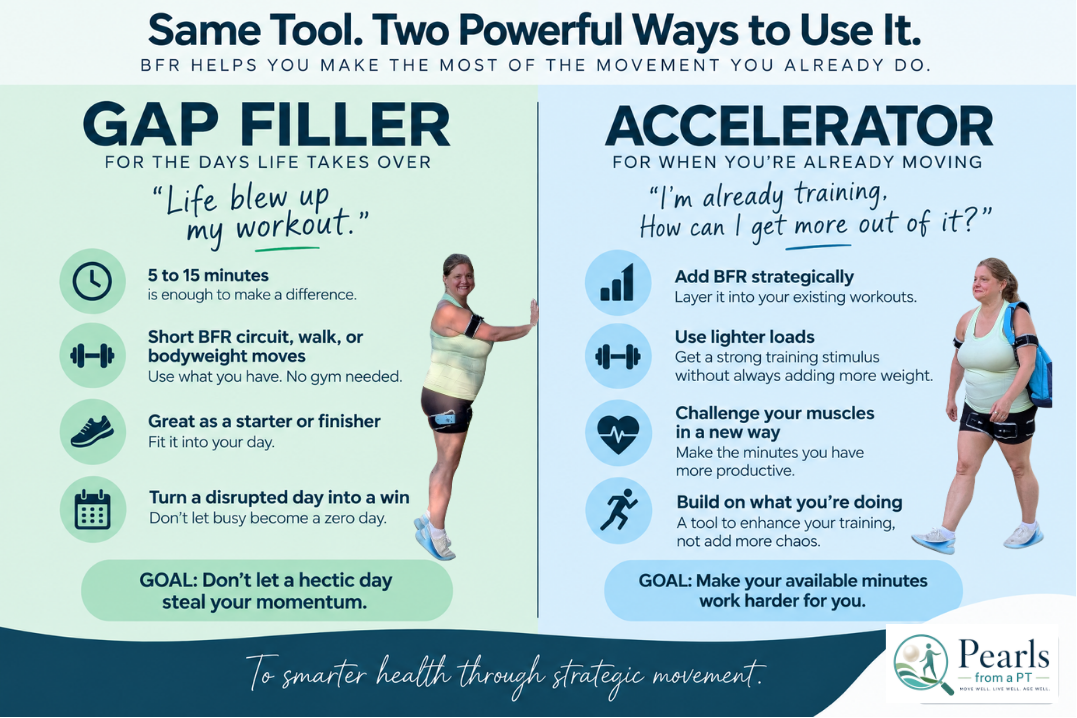
This is probably the simplest way I can explain how BFR fits into my own life. Sometimes it's a gap filler. Sometimes it's an accelerator.
As a gap filler, BFR gives me another option when the traditional workout simply isn't going to happen. Maybe I have five minutes. Maybe I have 10. Maybe I'm walking around my neighborhood and want to make part of that walk more challenging. Instead of deciding the day is a loss because I couldn't fit in a 45-minute workout, I can still create a meaningful movement win.
As an accelerator, I can layer BFR strategically into something I'm already doing, during part of a walk, added to a short strength circuit, or used as a starter or finisher.
There's actually a second way BFR fills a gap that I don't want to skip over. It isn't only about finding movement time. It's also about what this type of training may offer when used consistently. The research we've talked about throughout this article extends beyond muscle into areas including bone health, metabolic and cardiovascular risk factors, visceral fat, and early research on brain health. That doesn't mean one six-minute BFR session does all of those things, and it certainly doesn't make BFR a cure-all. It means this is a training tool with effects researchers are continuing to study across several systems, which is part of why I find it so useful and interesting.
The tool adapts to my life. My life doesn't have to adapt to the tool.
What Can Six Minutes Actually Do?
This is where I think traditional fitness sometimes loses people. We talk about 20-minute workouts as being short, and they are, but there are days when even finding 20 uninterrupted minutes feels like one more item on an already ridiculous list. Six minutes feels different.
I can do six one-minute movements back-to-back and create a surprisingly challenging circuit, changing the movement each minute so one area gets a break while another keeps working: bodyweight squats, calf raises, step-ups, a wall sit, or other movements that fit what my body can tolerate that day. That isn't the standard research protocol you'll see in many BFR studies. It's one practical way I use the tool based on my training, clinical experience and the reality of my schedule, and I can do it in my living room, outside my house, at a park or during a walk.
Watch my six-minute BFR circuit
The 90-Day Experiment That Taught Me Something Else
At one point, I used BFR almost every day for roughly 90 days while running a Facebook challenge. I felt incredibly fit, people commented on the muscle definition they were seeing, and I lost weight. Because I was doing the challenge publicly, I had also built a lot of consistency around moving every day.
Eventually I stopped, and for a long time I thought the problem was that doing BFR every day had simply become too much. Looking back, I don't think that was actually the problem. The five minutes of movement wasn't overwhelming. Filming the workout, editing it, posting it, coming up with another routine, and turning my movement into a piece of content every single day was.
The habit wasn't too big. Everything I had attached to the habit was.
That distinction has stuck with me because I see the same thing happen with exercise. We take something that could be simple and attach so many requirements to it that it becomes difficult to start.
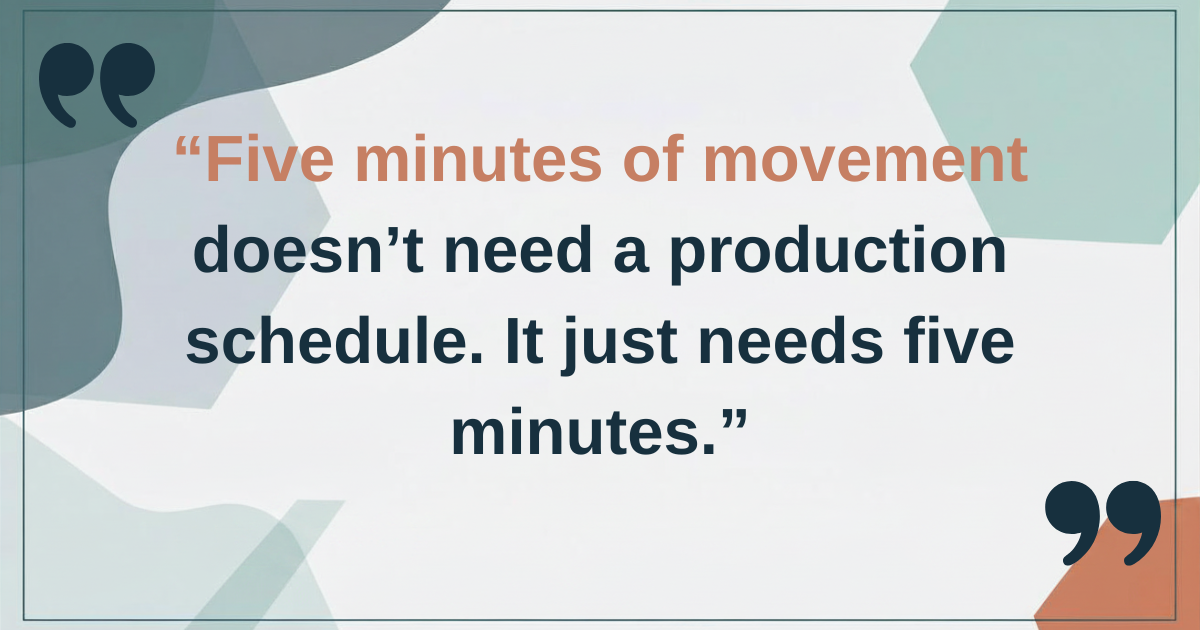
Five minutes of movement doesn't need a production schedule. It just needs five minutes.
And just to be clear, my 90-day experiment isn't a recommendation that everyone should use BFR every day. Many BFR training studies use protocols performed several times per week, and frequency should depend on the individual, the type of exercise, the system being used and the overall training plan.
This Isn't Only About Saving Time
Time is what gets people's attention, but it isn't the only reason I continue to use BFR. One of the things I appreciate most clinically is the ability to create muscular challenge without requiring the same external load we might use during traditional heavy resistance training, and I've seen how valuable that can be when someone wants or needs to build strength but heavier loading isn't currently a good option.
One patient who stands out was a physician in her late 50s or early 60s who became critically ill with COVID. She had been intubated, spent months on steroids and later developed significant knee problems, including osteonecrosis, with underlying osteoporosis. When we started working together, she could only perform about a quarter-depth squat. We incorporated BFR into her rehabilitation approximately three times per week, and over roughly six weeks, she progressed from that very limited squat to being able to move into a full crouch, with a major improvement in her knee pain and function.
Later, her DEXA scan also improved from the osteoporosis range into the osteopenia range. I can't say BFR was responsible for that change because she was also taking medication, and one person's experience cannot establish cause and effect.
That said, there is research suggesting BFR may support bone health more broadly. A 2025 systematic review and meta-analysis focused specifically on adults over 50 found that low-intensity BFR training produced greater improvements in bone mineral density than low-intensity training alone, along with favorable changes in several bone-related markers. Bone mineral density improvements were also similar to those seen with high-intensity resistance training in the studies that made that comparison. That doesn't prove what happened with my patient, but it's part of why her case made such an impression on me. What I could see clinically was how much function she regained while training with loads she could tolerate, and that reinforced something important for me: sometimes we don't need to make the external load heavier to make the exercise meaningful.
And Then There's the Metabolic Research
Back in May, when I was starting my own visceral fat experiment, I went looking into blood flow restriction research and found published studies examining BFR and visceral fat, with some showing meaningful reductions. That was part of why I built BFR into my experiment from the start.
More recently, a 2026 study published in Cell Metabolism gave us another interesting piece of that puzzle. Researchers studied adults with type 2 diabetes who completed 12 weeks of either low-load BFR resistance training or conventional resistance training. Both groups improved muscle strength. The BFR group did so despite training at a substantially lower load, and researchers also found improvements in skeletal-muscle mitochondrial capacity in the BFR group.
The visceral-fat finding caught my attention too. MRI-measured visceral adipose tissue volume decreased by 13.3% in the BFR group compared with 3.1% in the conventional resistance-training group. Only the BFR group's within-group change reached statistical significance.
That does not mean BFR causes everyone to lose 13.3% of their visceral fat. It was a small study in a specific population, adults with type 2 diabetes, using a specific 12-week training protocol. But combined with other emerging research examining BFR, body composition and visceral fat, I think it gives us another reason to keep paying attention. It also reinforces why I'm interested in BFR as more than a time-saving fitness tool, while recognizing that we still have a lot to learn.
What About Safety?
This is where I want to be especially clear because BFR isn't something I think people should approach with a "more is better" mindset. The entire point is that we can create a meaningful stimulus while using lighter loads.
BFR also isn't one standardized product. Different systems use different cuff widths, materials, pressures and protocols, and research involving pneumatic cuffs cannot automatically be translated into instructions for every elastic BFR system. I am specifically trained in the B3/B-Strong narrow elastic band system, so that is the system I can speak to from my own training and experience.
With B3/B-Strong, the bands are positioned high on the limbs, near the top of the upper arm or high on the thigh. I follow the prescribed pressure guidance for that system, and the B3 protocol I was trained in limits a continuous BFR bout to approximately 20 minutes. If someone is doing a longer activity, the bands can be deflated for a period before another appropriate bout. Those are B3-specific guidelines, not universal instructions for every BFR device.
BFR also requires appropriate screening. A history or risk of blood clots, vascular disease, uncontrolled hypertension, certain cardiovascular conditions, active infection, renal concerns, pregnancy and other medical conditions may require additional precautions or may make BFR inappropriate. If you have a medical condition, take medications that affect clotting or circulation, or simply aren't sure whether BFR is appropriate for you, talk with your physician or a healthcare professional trained in BFR before starting.
And please don't assume tighter or heavier is better. The goal of BFR is not to see how much pressure or load you can tolerate.
What Does This Look Like in Real Life?
What this looks like in real life can actually be pretty simple. Sometimes I'll start a walk wearing my B3 bands, use them for part of the walk, then deflate them and put them in my backpack. Sometimes I use them toward the end. Sometimes I'll combine a walk with a short "burner" first, wall sits, squats, calf raises or step-ups, and then walk. Sometimes I'm already doing a workout and use BFR strategically with lighter resistance.
And sometimes I don't use BFR at all, which matters just as much as the times I do. No single tool needs to be part of every workout. BFR is simply one option in a much bigger movement toolbox.
Dr. Mike DeBord has said it well: BFR "can be incorporated into walking, strength training, bodyweight exercise, or a short workout at home." That flexibility is part of why it's stayed useful to me for this long. It bends around whatever I'm already doing instead of asking me to build a workout around it.
Getting More From the Exercise You Have Time to Do
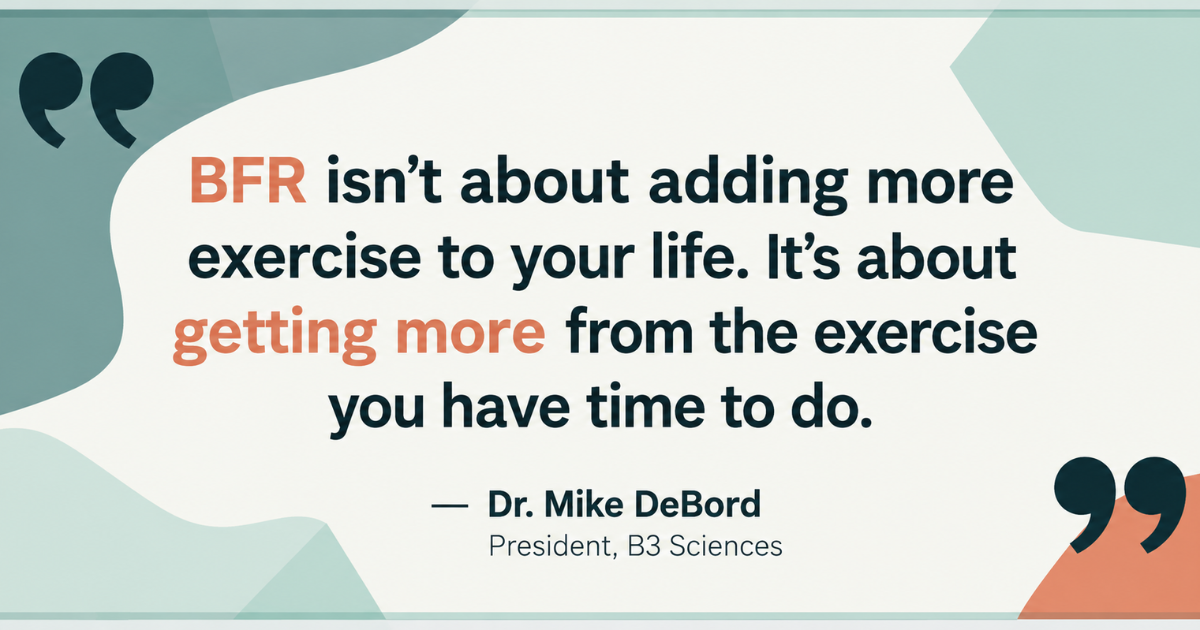
When I reached out to Dr. Mike DeBord, President of B3 Sciences, while writing this article, he described the idea in a way that fits exactly how I use BFR:
"BFR isn't about adding more exercise to your life. It's about getting more from the exercise you have time to do."
That captures what I've come to appreciate about BFR. I don't need another complicated exercise program fighting for space in my calendar, and most people I work with don't either. We need ways to keep moving when the week doesn't cooperate, ways to challenge muscle when heavier loads aren't a good fit, and ways to make exercise work with the life we actually have.
Some days I have time for a full workout. Some days I have time for a walk. Some days I have six minutes. The goal isn't to make all three days look the same. The goal is to keep making useful choices for the body I want to carry into the future.
Want to Try BFR?
If you're curious about blood flow restriction training, I created two resources to help you understand how I use it. My BFR Starter Kit walks you through the basics, and my BFR Circuit Walk gives you a practical way to combine BFR with walking and movement intervals.
If you decide B3 Bands are right for you, you can see the system I personally use here. When you purchase through my link, I also provide a $50 discount. You’ll see the discount applied when you add the bands to your cart and proceed to checkout.
Remember, the goal isn't to cram more exercise into an already crowded life. It's to get smarter about the movement you can actually do.
To smarter health through strategic movement,
Lori
Your Movement Detective
P.S. Enjoyed this Pearl of Wisdom? Don't miss the next one! If this was forwarded to you,[click here] to subscribe so you get every new post sent directly to your inbox.
RESEARCH & FURTHER READING
1. Abe T, Fujita S, Nakajima T, et al. Effects of Low-Intensity Cycle Training with Restricted Leg Blood Flow on Thigh Muscle Volume and VO2MAX in Young Men. Journal of Sports Science and Medicine. 2010;9(3):452-458. This small study compared 15 minutes of low-intensity BFR cycling with substantially longer conventional low-intensity cycling and found improvements in thigh muscle size and aerobic capacity in the BFR group.
2. Centner C, Wiegel P, Gollhofer A, König D. Effects of Blood Flow Restriction Training on Muscular Strength and Hypertrophy in Older Individuals: A Systematic Review and Meta-Analysis. Sports Medicine. 2019;49(1):95-108.
3. Seo DI, So WY, Sung DJ. Effect of a low-intensity resistance exercise programme with blood flow restriction on growth hormone and IGF-1 levels in middle-aged women. South African Journal for Research in Sport, Physical Education and Recreation. 2016;38(2):167-177.
4. Nakajima T, Kurano M, Iida H, et al. Use and Safety of KAATSU Training: Results of a National Survey. International Journal of KAATSU Training Research. 2006;2:5-13.
5. Stray-Gundersen S, Wooten S, Tanaka H. Walking With Leg Blood Flow Restriction: Wide-Rigid Cuffs Versus Narrow-Elastic Bands. Frontiers in Physiology. 2020;11:568.
6. Trinks N, Gancheva S, Pützer J, et al. Blood-flow restriction resistance training improves skeletal muscle mitochondrial capacity and cardiovascular risk factors in type 2 diabetes. Cell Metabolism. 2026;38(4):812-823.e6. doi:10.1016/j.cmet.2025.12.016.
7. Li S, Guo R, Yu T, Li S, Han T, Yu W. Effect of High-Intensity Interval Training Combined with Blood Flow Restriction at Different Phases on Abdominal Visceral Fat among Obese Adults: A Randomized Controlled Trial. International Journal of Environmental Research and Public Health. 2022;19(19):11936. doi:10.3390/ijerph191911936.
8. Landers JB, Landers KR, Young NG. The Effects of Blood Flow Restriction Exercise on Muscle-Brain Crosstalk: A Systematic Review. Muscles. 2025;4(2):19. doi:10.3390/muscles4020019. This systematic review examined five studies involving BFR and serum BDNF. The authors concluded that BFR shows promise for neurotrophic support and potentially brain health, while emphasizing that small samples and varied protocols prevent definitive conclusions. Read the study
9. Liu Y, Zhang Y, Wang T, Gao Z, Wang X. Systematic review and meta-analysis of the effects of blood flow restriction training on bone health in older adults. Scientific Reports. 2025;15:12800. doi:10.1038/s41598-025-98053-5. Read the study


