Consistency Doesn't Mean Doing the Same Thing Every Day
This post contains affiliate links to products I personally use and recommend. If you purchase through one of these links, I may earn a small commission at no additional cost to you.
There's an old saying about the best laid plans going awry. Mine certainly did.
On Friday, August 14, I finished another round of a little experiment I had quietly been running on myself. I had started doing short walk/run intervals, nothing dramatic, just five 30-second running intervals mixed into a longer walk. That might not sound like much, but I hadn't run in years, and running had actually become one of those things I'd written off completely.
A few years ago I tried to run with my daughter, and it didn't go well. I ended up with foot pain that lingered for months, which I now suspect had a lot to do with perimenopause, since foot pain has become one of my more frustrating symptoms. At the time, I just decided running wasn't something my body could handle anymore, and I let it go. Looking back, I think the real problem wasn't that I couldn't run. It's that I tried to run too far, too soon, instead of building into it the way I'd tell any of my patients to.
So this time I did it differently. I walked, ran for 30 seconds, walked again, then ran another 30 seconds, five rounds total with longer walking on either end. That was it. And I could do it. Even better, as I practiced it, it started getting easier. I wasn't becoming a runner overnight. I was rebuilding capacity in a way my body could actually tolerate, and more importantly, I was starting to question a limit I'd put on myself years ago without ever really testing it again.
I had also been experimenting with how different tools changed the cardiovascular demand of a neighborhood walk. I'd already shared how I reached Zone 4 during a 23-minute walk using BFR and my weighted vest, but behind the scenes I was testing the pieces separately too, and my next experiment was supposed to combine the weighted vest, BFR and those short running intervals. I was excited to see what happened.
I never got to do it.
When the plan changed overnight
That night, I rolled over in bed, stretched, and felt a twist and crack through my back followed by immediate sharp pain. The pain started radiating down my right arm almost right away, and more than a week later, it was still there. My right grip strength measured about 15 pounds below my left, and pinching, lifting, gripping, pushing, pulling and carrying all became difficult. Sleep was restless too, because finding a comfortable position was nearly impossible, and I'd wake up, shift around, sometimes get up and do a few movements that seemed to help, then try again.
And life did not conveniently clear my calendar so I could deal with it. My kids had just gone back to school, so our relaxed summer schedule disappeared almost overnight. We were also in the middle of kitchen construction, with contractors coming and going, countertop appointments, cabinet work, electrical problems and constant trips to hardware stores. I still had a full patient schedule too, including hands-on work that's considerably harder when your dominant hand isn't cooperating.
We basically went from summer to Mach 10 in a week.
My carefully planned running experiment was sidelined.
I couldn't follow the plan. I could still make choices.
The first weekend, I did almost nothing. Movement hurt, my arm hurt, sleep was poor, and honestly I felt miserable. That was the right call for those couple of days. But as things settled slightly, the question in my head changed from "can I do my workout" to something a lot more useful: what can my body actually tolerate today?
I couldn't use my weighted vest, and I tried the vibration plate once on a very low setting, didn't like how my symptoms responded, and stopped. Upper-body strength work was largely off the table too. But walking was tolerable, so I walked when I could, some days for 10 or 20 minutes, one day for almost 40 with my husband, another day for close to an hour with a friend.
There was also plenty of movement that would never qualify as a workout. Trips through Home Depot, running up and down the stairs for the contractors, moving things around the house, demonstrating exercises at work, changing positions constantly because sitting still made everything worse. Small bouts like these are exactly what I mean when I say movement snacks count, something I've written about before, and this week was proof of it in real time.
That all counts too.
This is exactly why I built my three-tier approach to movement around what actually fits into real life, instead of relying only on formal workouts.
I adapted the movement too
I kept doing the corrective movements that felt helpful and backed away from the ones that didn't. Wall push-ups and a wall-supported plank with three-dimensional hip drives both stayed in the mix, along with my foam roller and frequent movement resets. I actually shared that wall plank as a recent Mobility Monday, and it's become one of my favorite resets, not just for radiating nerve pain but for anyone who's been sitting too long and needs to unstick their hips. I also experimented carefully with modified BFR when it felt appropriate, instead of trying to force my normal training just because I usually use it.
At work, I even let a coworker dry needle me, and anyone who knows how needle-phobic I am understands how much that says about the week I was having. It didn't resolve the nerve symptoms, although some of my restricted movement did improve.
At this point, because the symptoms and strength changes have persisted despite everything I've tried conservatively, I'm also pursuing a medical evaluation. Being a physical therapist doesn't mean I keep treating myself indefinitely. Sometimes adapting the plan means knowing when the next appropriate step is getting another set of eyes on the problem.
This is my personal experience, not a diagnosis or medical advice. New or persistent radiating pain, weakness or other concerning symptoms deserve appropriate evaluation.
A rest day is not a zero day
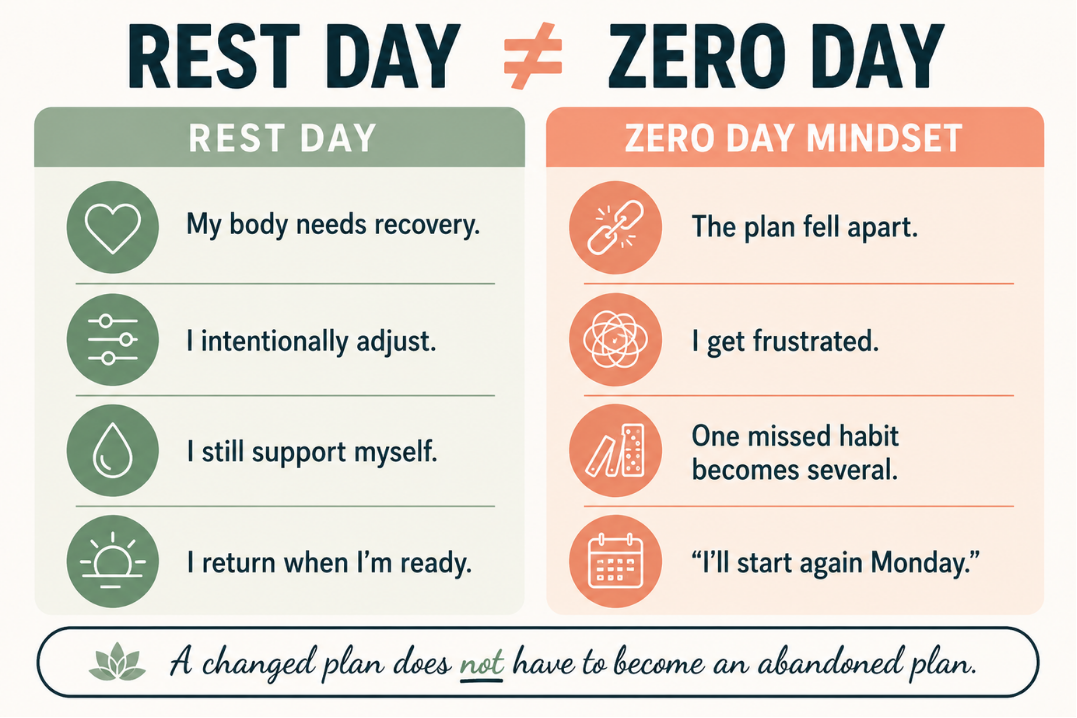
This distinction matters to me, maybe more than anything else in this whole story. A rest day can be an intentional, healthy decision. A zero-day mindset is something different entirely. That's when the workout falls apart, frustration takes over, and suddenly the whole day feels shot. "I missed my workout, so I might as well order whatever." "I didn't get my walk in, so today doesn't count." "I'll just start again Monday." One missed thing starts recruiting friends, and that's the trap I try hardest to avoid.
And no, I wasn't perfect
One particularly stressful day, I ate a Philly cheesesteak and french fries. I hadn't had that kind of meal in months, and I enjoyed every bite of it. It was comfort food after a hard day, one meal, not a decision to throw away everything else I'd been doing. The next meal didn't need to become another splurge just because I'd somehow "blown it," and that matters too.
Adaptable consistency isn't another way of demanding perfection. Most days I still tried to build balanced meals despite a kitchen that wasn't fully functioning and a husband dealing with his own digestive issues, sometimes getting creative, sometimes leaning on thoughtful takeout. I kept drinking my water, kept working on sleep even when pain made that difficult, and kept making the next reasonable choice I could.
Health is rarely determined by one cheesesteak, one missed workout or one rough night. It's what happens next that matters.
What my data showed this time
I'm still tracking the same body-composition experiment I started earlier this summer, using my Hume Health Body Pod scale, the same tool I've been using through this whole process.
During this disrupted stretch, I wasn't doing my normal strength work, wasn't wearing my weighted vest, and my sleep and stress were both clearly affected. My movement looked nothing like my usual plan. Yet my visceral fat index held at 13, and my most recent scale measurement was actually the lowest weight reading I've recorded during the whole experiment, although I'm intentionally not sharing the exact number here because the number itself isn't the point.
I want to be careful about what I make of that. I cannot say walking caused it. I cannot say BFR caused it. I cannot say one week proves that my system "worked." This is one small slice of a much longer experiment with plenty of variables at play. What actually interested me was simpler than any of that: a messy week happened, and it didn't automatically erase everything that came before it. That matters because one of the fastest ways to turn a difficult week into a difficult month is convincing yourself you've already lost all your progress.
There's some research that backs up that reassurance too. A 2024 randomized study found that people who took a one-week break from resistance training didn't see meaningful differences in muscle growth, muscular endurance or power compared with people who kept training, although the group that trained continuously still made better strength gains. Research in middle-aged and older adults suggests something similar, that some strength gains can persist through a training interruption depending on how long you trained beforehand and how long the break lasts. In other words, a short disruption and abandoning movement for months are two very different things.
Your readiness score is one clue
My Oura data made this week particularly interesting. There were days when my readiness score looked pretty good even though I felt awful because of the pain, and at the same time my stress data started showing accumulating stress along with the restless sleep I already knew was happening.
That's a perfect example of why I don't want a wearable making decisions for me. It gives me information. It doesn't know the whole story. The detective doesn't solve the case with one clue.
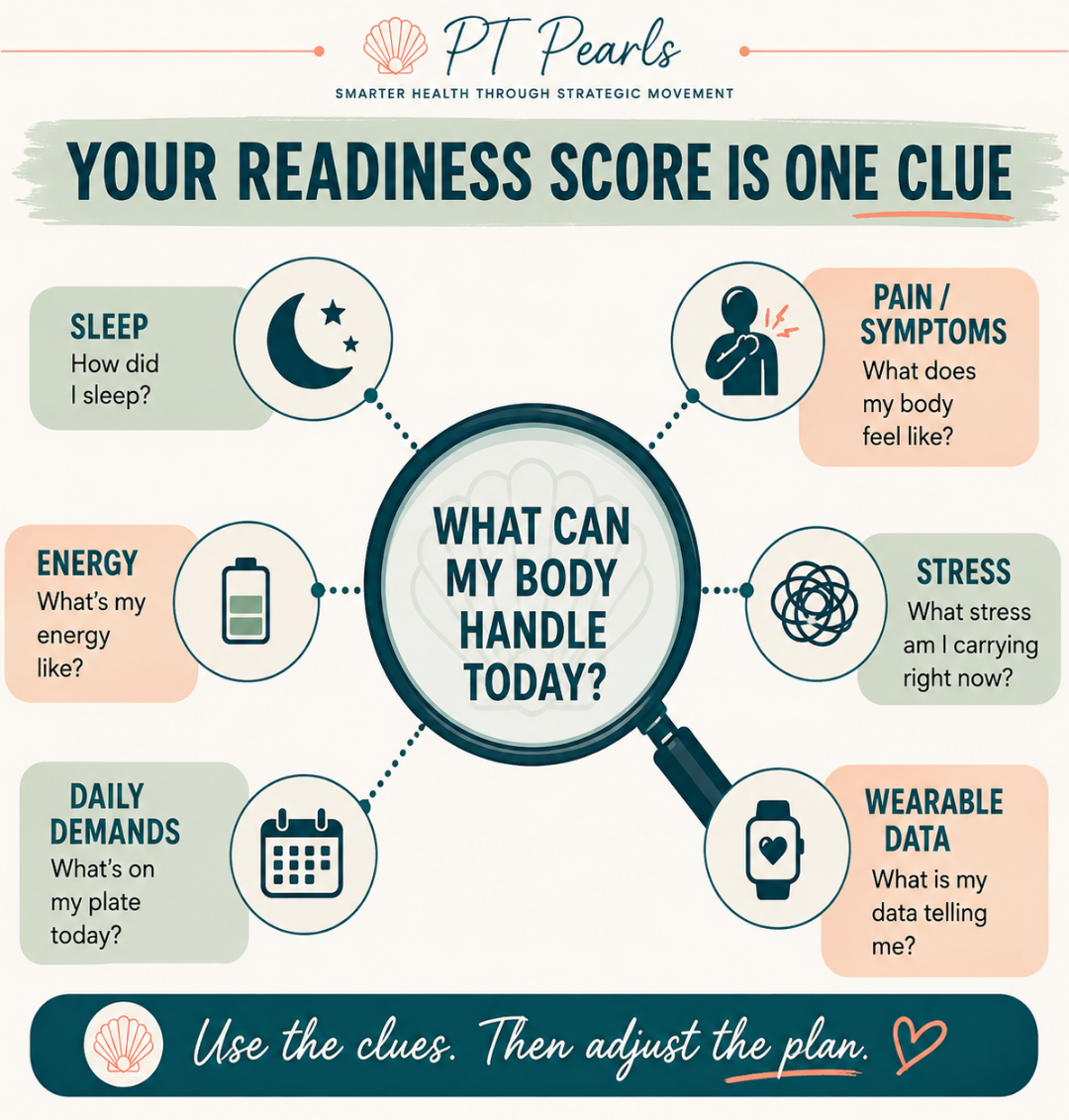
That readiness check also connects to something I wrote about recently. Strength is only one part of being capable, and control, stability, power and recovery matter just as much.
The plan should respond to the person
There's actually a name for adjusting training based on current performance, fatigue and readiness. It's called autoregulation. But you don't need the terminology to use the principle, because your body today is already giving you information. Maybe you slept terribly. Maybe your knee is cranky. Maybe work exploded, or your child is sick, or you actually feel fantastic and today is the day to push a little harder.
The goal isn't to ignore the plan. It's to stop treating the plan as if it knows more about today than you do. Your plan is a starting point, and then you gather the clues.
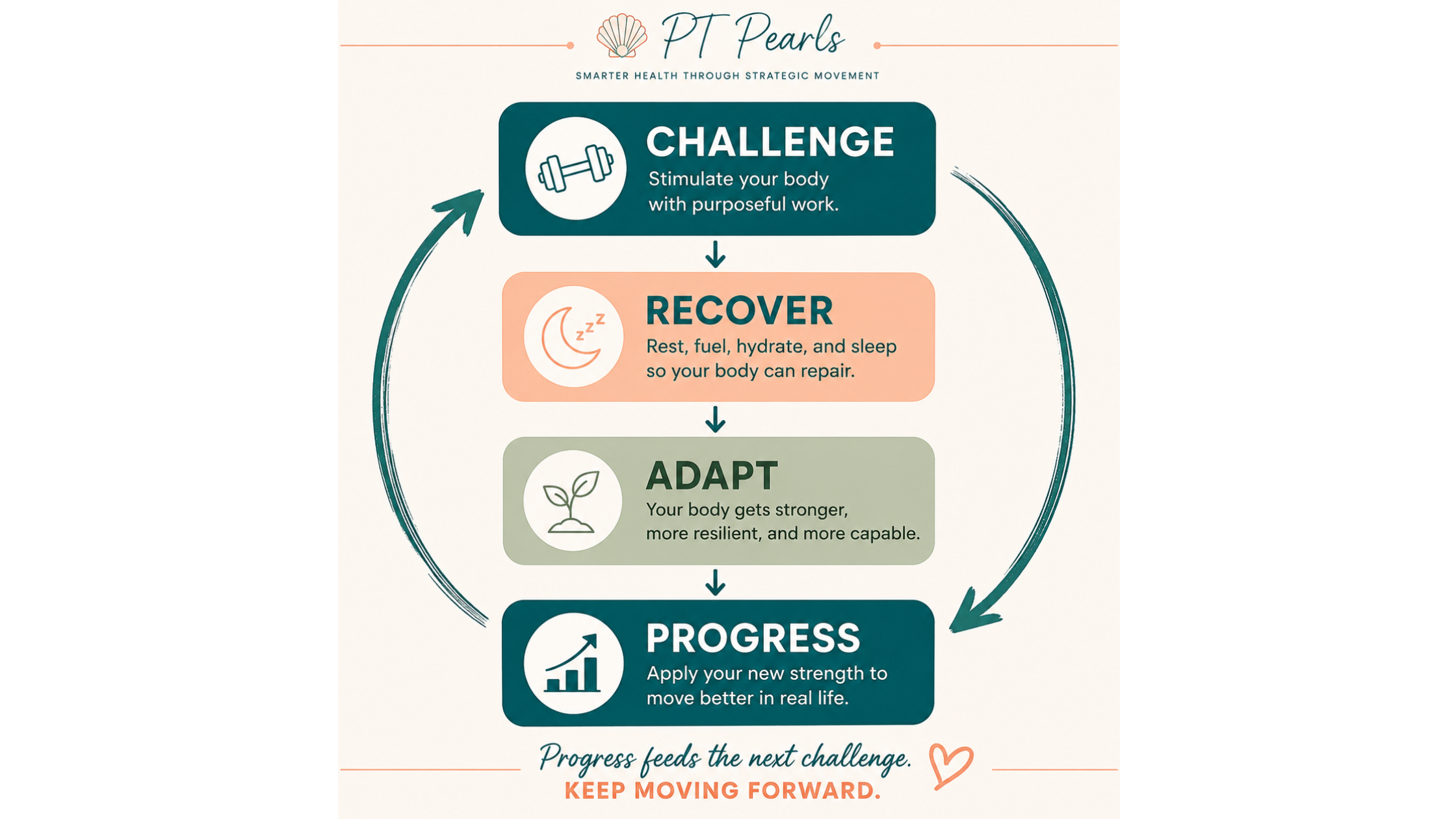
I lost some running momentum. I didn't lose the idea.
Am I disappointed that my running experiment got interrupted? Absolutely. I was discovering something about myself that I hadn't expected, after years of assuming I couldn't run anymore. Then five little 30-second intervals showed me I'd probably been underestimating what my body could still do, and that experiment isn't over. It's paused, and when my body is ready, I want to go back and finish it. There's an important difference between those two things.
What can you do today?
Maybe nothing hurts, and your disruption has nothing to do with an injury at all. Your plan still gets interrupted. Work runs late, school starts, someone gets sick, you travel, you sleep badly, or you simply have one of those days where the workout you planned at 7 a.m. is laughable by 5 p.m.
Before you call it a zero day, investigate a little. Ask yourself what you can actually do today, what needs to be modified, what genuinely needs rest, and what other part of your health you can still support. Maybe the answer is your normal workout. Maybe it's a 10-minute walk, a few movement snacks between meetings, one decent meal, drinking your water, or just getting to bed a little earlier. And sometimes, honestly, the smartest choice really is rest.
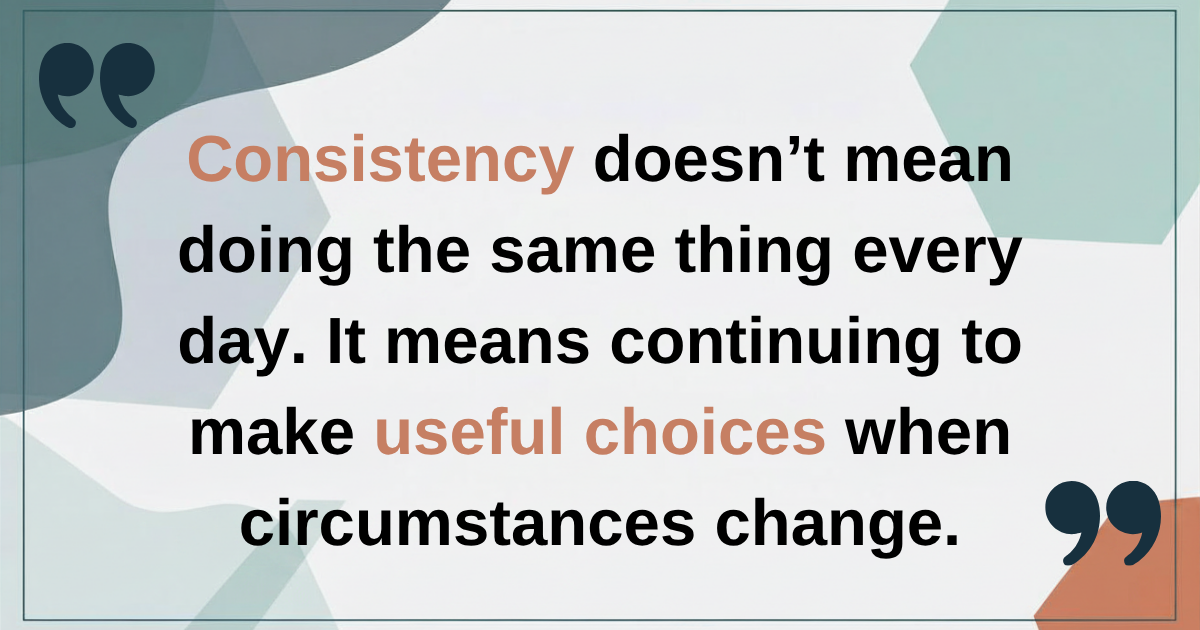
Consistency doesn't require the same answer every day. It requires you to keep asking the question.
Final thought
Your challenge this week is simple. When your original plan falls apart, don't automatically write off the whole day. Find the next useful choice, and make it. That's adaptable consistency, and in real life, I think it's the kind of consistency that actually lasts.
P.S. Enjoyed this Pearl of Wisdom? Don't miss the next one! If this was forwarded to you,[click here] to subscribe so you get every new post sent directly to your inbox.
Lori Diamos, MS, PT, FAFS
Physical Therapist and Founder of PT Pearls
To smarter health through strategic movement,
Lori
Your Movement Detective
Sources:
1. Coleman M, Burke R, Augustin F, et al. "Gaining more from doing less? The effects of a one-week deload period during supervised resistance training on muscular adaptations." PeerJ. 2024;12:e16777. PubMed | Free full text (PMC)
2. Yang Y, Chen SC, Chen CN, et al. "Training Session and Detraining Duration Affect Lower Limb Muscle Strength Maintenance in Middle-Aged and Older Adults: A Systematic Review and Meta-Analysis." Journal of Aging and Physical Activity. 2022;30(3):552-566. PubMed


