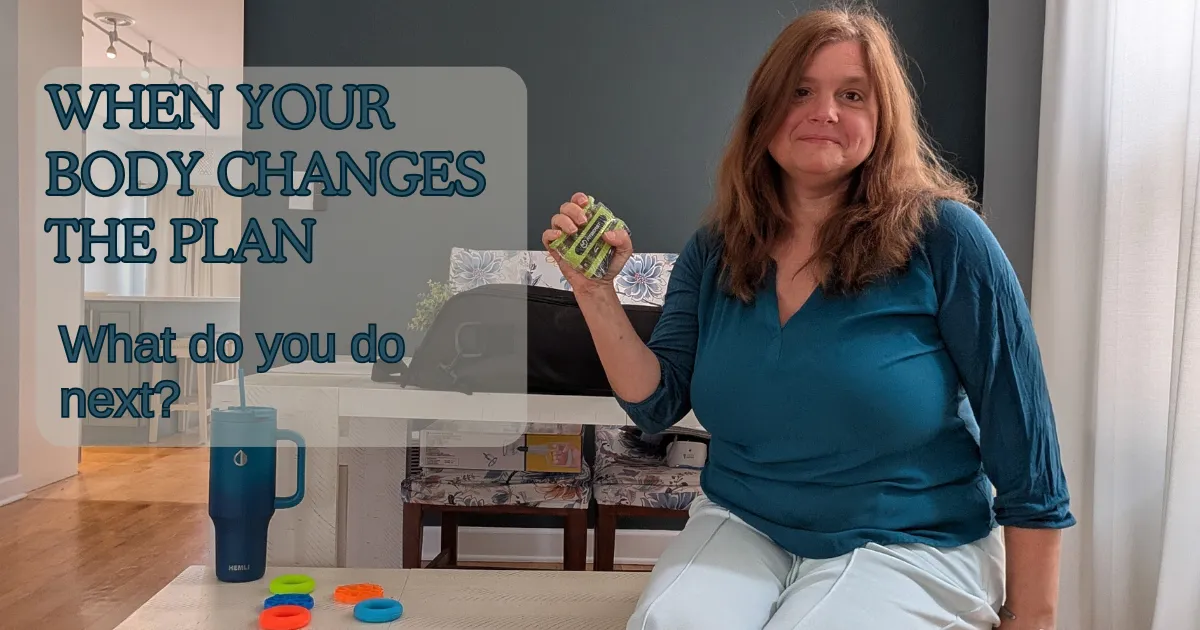
What Happens When the Plan That Was Working Suddenly Isn’t?
Disclosure: This post contains referral and practitioner links. If you purchase through one of my links, I may receive a commission or referral credit at no additional cost to you. I only share products and tools I personally use or believe may be helpful.
Have you ever finally gotten into a good rhythm with your health, only to have life, or your body, suddenly change the plan?
That question has been on my mind a lot lately because what started as my “visceral fat experiment” has turned into something much bigger. And it definitely hasn’t gone according to plan.
Why I Started This Experiment in the First Place
My own body has changed dramatically over the past several years. Long-haul COVID took a toll, then came the hormonal changes of perimenopause, weight gain and changes in my body composition.
As a physical therapist, I knew many of the things I should be doing. But knowing what to do and consistently applying it to my own busy life were two very different things.
Then I was asked to contribute to an EatingWell article about exercises that can help reduce visceral fat after 50. Visceral fat is the deeper abdominal fat that surrounds our internal organs, and unlike the fat we can pinch under our skin, higher levels are associated with greater health risks.
As I researched the article and started paying more attention to the visceral fat estimate on my own Hume Health scale, which uses bioelectrical impedance to estimate body composition, I had an uncomfortable realization.
I had the knowledge. I had access to some pretty incredible tools. I just wasn’t consistently using them in a way that helped me.
That became the catalyst.
What Started as a Visceral Fat Experiment
At first, I had a pretty specific target. Could I reduce my visceral fat while maintaining or building muscle by changing how often I moved and how I used the time I actually had?
I wasn’t interested in creating another plan that required me to find 45 to 60 uninterrupted minutes every day. I’m a physical therapist, wife, mom of two busy teenagers and business owner. There are days when that kind of time simply isn’t available.
So instead of starting with the traditional workout, I started with minutes.
I began paying more attention to the one to three-minute movement snacks I could accumulate throughout my day. I added more intentional strategic movement when my readiness and schedule allowed. Sometimes that might be six minutes. Sometimes it might be 20. What made it strategic wasn’t the clock. It was choosing the movement on purpose based on what I wanted my body to work on that day.
Sometimes I used tools such as my weighted vest, a vibration plate that creates rapid mechanical vibrations while I move or exercise on it, or blood flow restriction training. BFR uses bands around the upper arms or legs to make muscles fatigue more quickly while exercising with lighter loads. Other times I used nothing but my body.
And when I had the time and capacity for a longer walk, strength workout, yoga or Pilates class, or another longer activity, those minutes mattered too.
I started calling this Minutes That Move the Needle.
The longer sessions didn’t disappear. They became the bonus rather than the price of admission.
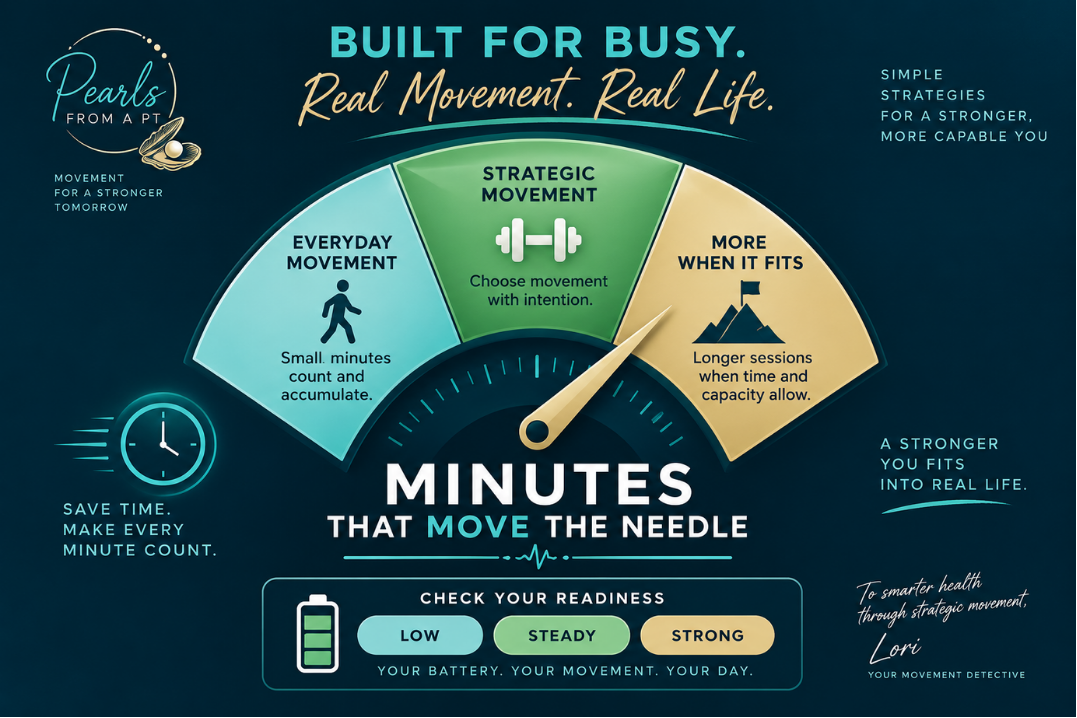
An important part of the whole idea was checking my readiness before deciding what movement should look like that day. I use a simple battery check of low, steady or strong, along with how I actually feel and information from my Oura Ring, a wearable that tracks things such as sleep, recovery and stress.
Then life gave me a much bigger test of that idea than I had planned.
When the Physical Therapist Became the Patient
In mid-August, I rolled over in bed in my sleep, stretched and felt a crack in my upper back. I immediately had pain radiating down my right arm.
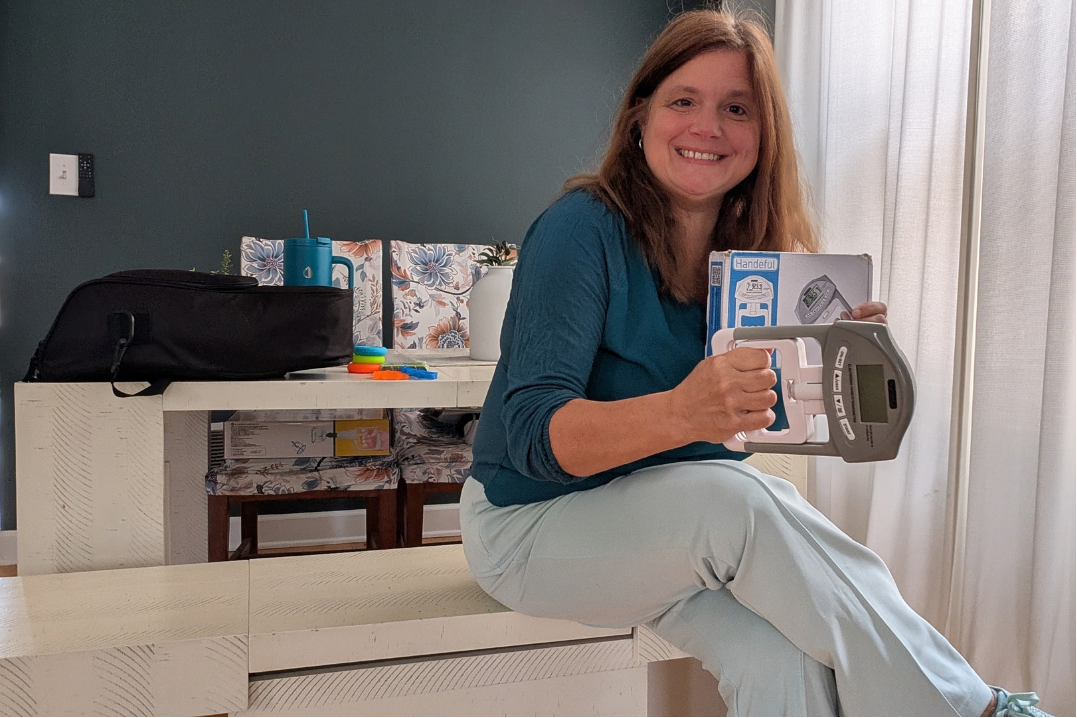
Within about three days, I had lost roughly 15 pounds of grip force in my right hand. At the worst point, I was down about 25 pounds.
Initially, I modified activities, found positions that were more comfortable and used some of the strategies I knew as a PT. But this wasn’t ordinary soreness. The pain persisted, and I was experiencing significant weakness and loss of function. That was my cue that I needed more information, so I sought medical care. An MRI and medical evaluation confirmed a C7-T1 disc herniation.
Literally overnight, the physical therapist had become the patient.
The grip measurements gave me an objective number, but everyday life made the weakness much more real. Getting dressed was harder. Opening certain containers was difficult. I couldn’t effectively hold and twirl the big round brush I normally use to blow-dry my hair.
So for about three weeks, I went curly. I let my hair air-dry, worked with its natural wave and did almost nothing to it. This week, I finally started blow-drying it again.
It seems like such a small thing until you can’t do it.
The weakness affected my work too. I use my hands all day as a physical therapist to support patients, stretch them, perform manual techniques and demonstrate exercises. I wasn’t only wondering when I would exercise normally again. I was wondering what persistent hand weakness could mean for my ability to do my job.
It also gave me a different appreciation for conversations I’ve had with my dad, who is in his late 80s and lives alone. He talks about weaker hands and legs making everyday tasks around his home more difficult. I understood what he meant before, but temporarily losing some of my own capability made me understand it differently.
That’s the part of strength and movement we sometimes forget. Muscle and body-composition numbers matter, but eventually those numbers show up in our lives as capability.
When Parts of the Plan Had to Stop
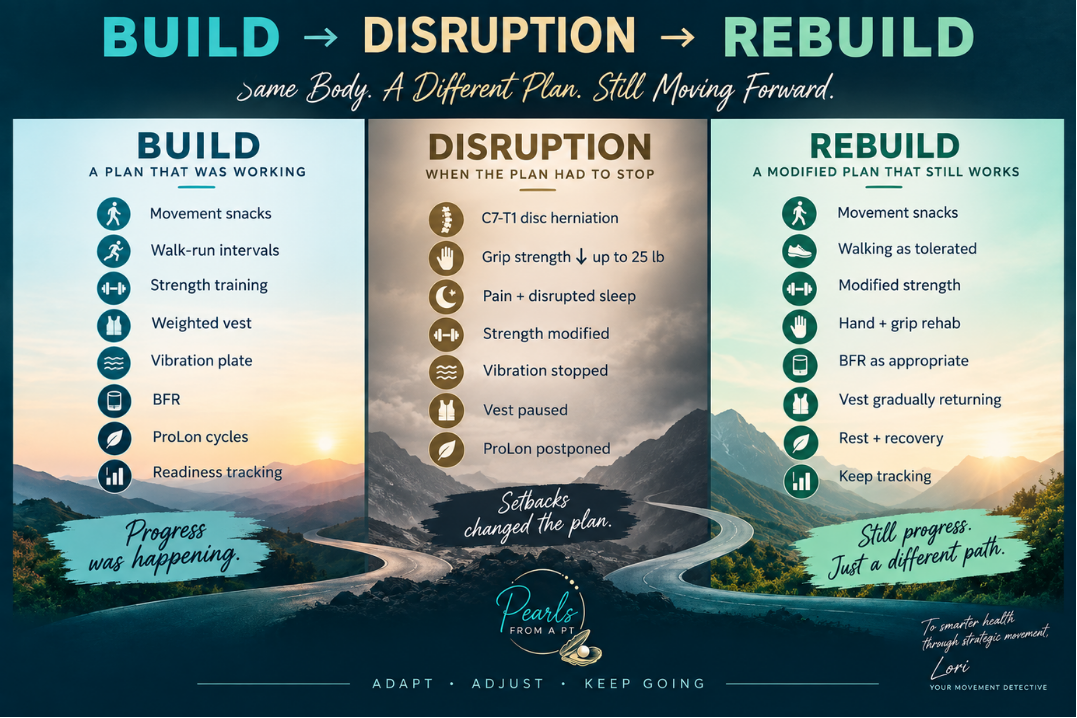
The injury changed what I could do almost immediately. I stopped using the vibration plate. Weighted-vest work initially stopped. Strength training had to be significantly modified, especially for my upper body, and the walk-run intervals I had been enjoying came to a halt.
I was also supposed to begin my next monthly cycle of ProLon, a five-day fasting-mimicking diet. I had planned three monthly cycles based on the protocol used in published research. In one study, three monthly cycles were associated with improvements in several cardiometabolic markers and a nearly 2.5-year decrease in median estimated biological age, a research measure calculated from several clinical health markers rather than simply the number of years someone has been alive.
Between the pain, disrupted sleep and prescription medication, including a Medrol steroid dose pack, I decided this wasn’t the time to add another stressor to my body. I postponed the cycle until I felt I was in a better place to do it.
But stopping some things didn’t mean everything had to stop.
What Was Still Available?
This became the question I kept asking myself.
What is my body still successful at today?
Staying completely still often made me more aware of the nerve discomfort. I frequently felt better when I found a movement, position, load or weight-bearing activity my body tolerated, so I kept looking for those opportunities.
The one to three-minute movement snacks that were already part of my days continued to be part of them. I did plenty while working with patients. I walked when I could. I continued lower-body movement and used BFR where it was appropriate and didn’t aggravate my symptoms. For my hand and upper body, I gradually added things such as wall push-ups, gentle isometrics, grip work, finger extension and opposition as tolerated.
Those small bouts weren’t the substitute for the “real” exercise I could no longer do. They were already part of the foundation I had been building.
All movement matters, even when we don’t traditionally call it exercise. Those minutes add up.
There were also times when what I needed most was rest. Pain had disrupted my sleep, and there were weekends and afternoons when I took a nap because I needed one. Resting when my body needed recovery was just as intentional as finding movement when movement felt good.
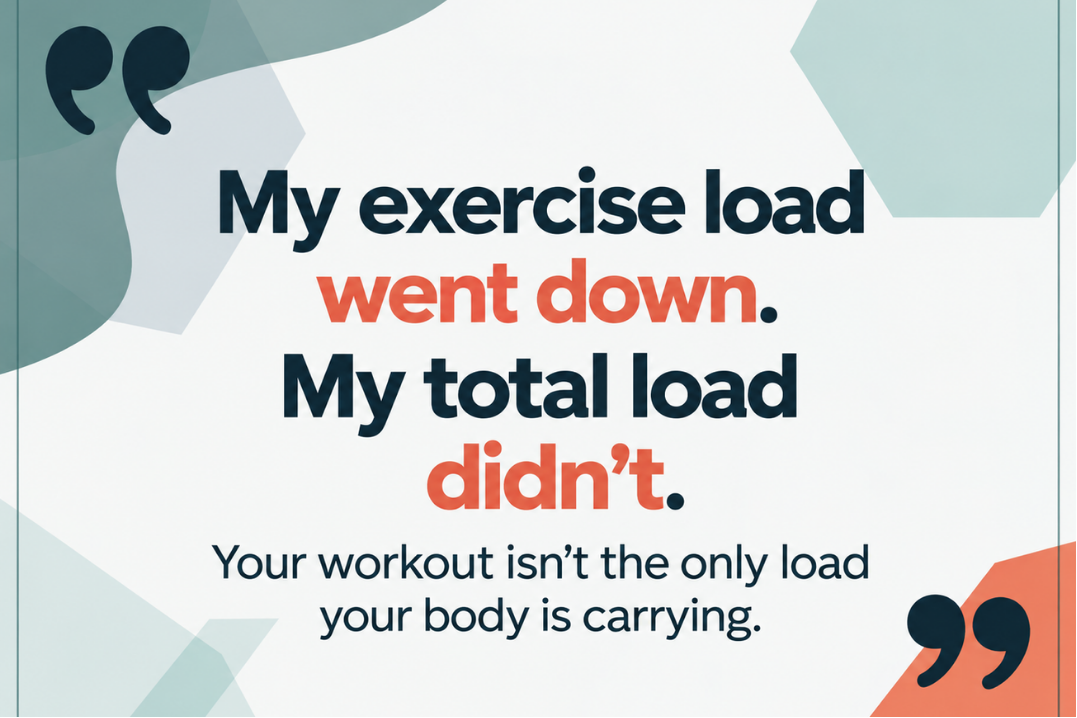
My Exercise Load Went Down. My Total Load Didn’t.
This experience also reminded me that exercise is only one part of what our bodies are dealing with.
My exercise load had dropped considerably, but I was dealing with pain, poor sleep, weakness, changes in normal daily activities, work demands and the worry that came with not knowing how quickly my hand would recover.
During this same period, the cumulative stress information I was seeing through my Oura Ring moved from moderate to high. I can’t say that pain caused that change. There were too many variables involved. But it was another piece of information that reminded me to look at the whole picture rather than judging my readiness by whether I had exercised that day.
That’s why the readiness check matters to me. How do I actually feel today? Is my battery low, steady or strong? What does my body have available? What needs more recovery?
The answer can change from one day to the next, and the movement can change with it.
And What Happened to My Numbers?
I kept collecting information throughout all of this.
Near the beginning of the experiment, my Hume Health scale estimated my visceral fat index around 17. For the past several weeks, it has remained around 12 to 13, mostly 13. My estimated skeletal muscle has also stayed within a relatively consistent range.
That surprised me, but I want to be careful about what those numbers mean.
The Hume Health scale uses bioelectrical impedance, so hydration and other variables can affect its estimates. This also isn’t a controlled scientific experiment. My movement changed. My sleep changed. My stress changed. I took medication. I postponed ProLon. Even the weather affected how consistently I walked outside.
So I can’t tell you that BFR maintained my visceral fat, movement snacks preserved my progress or that any one part of my routine caused those numbers to stay where they did.
What interested me was simply that they didn’t change as much as I expected while so much else had changed.
I’ll keep measuring and see what happens next.
Maybe I Named the Experiment Wrong
Visceral fat was the catalyst for all of this. It gave me a measurable target and made me take a closer look at whether I was consistently applying what I already knew about movement and health to my own life.
But somewhere along the way, Minutes That Move the Needle became the more interesting experiment.
Could I stop treating movement as something that only counted when I had time for a traditional workout? Could I make small amounts of movement so repeatable that they became part of everyday life, then layer in more strategic movement and longer activities when my readiness, goals and schedule allowed?
The disc herniation tested that idea in a way I never expected.
Before the injury, Minutes That Move the Needle helped me fit movement into a busy life. After the injury, it helped me think differently about movement when my physical capacity changed.
What Does This Mean for You?
Your disruption probably won’t look exactly like mine.
Maybe it’s an injury. Maybe your knee is acting up. Maybe you’re navigating hormonal changes, poor sleep or a stressful season. Maybe work is overwhelming, your kids need more from you, you’re helping an aging parent or you simply don’t have the time today that you thought you would.
The traditional workout may not always fit.
That doesn’t mean movement has to disappear.
Instead of starting with everything you can’t do, try asking what your body is successful at today. Maybe you find a few minutes between meetings. Maybe you walk. Maybe you do some intentional strength work. Maybe you have plenty of capacity and get to enjoy that longer workout, yoga class, Pilates session or pickleball game.
NOT SURE WHAT MOVEMENT FITS TODAY?
Your schedule changes. Your energy changes. Your body changes. Your movement can change with them.
I created a free 60-Second Readiness Check to help you check your battery, look at the time and capacity you actually have today, and choose movement that fits.
Get the free 60-Second Readiness Check here.
And sometimes the answer really is recovery.
Listening to your body also means knowing when something needs more attention. Persistent or worsening symptoms, significant weakness or changes in function shouldn’t simply be ignored while you search for another exercise you can tolerate. Sometimes the next smart step is getting appropriate medical help.
Where I Am Now
At my lowest point, my right-hand grip strength was down about 25 pounds. Now that the pain has settled and I’ve finished my Medrol dose pack and pain medication, I’m still about 15 to 20 pounds below my previous grip strength, but I’m seeing signs that things are moving in the right direction.
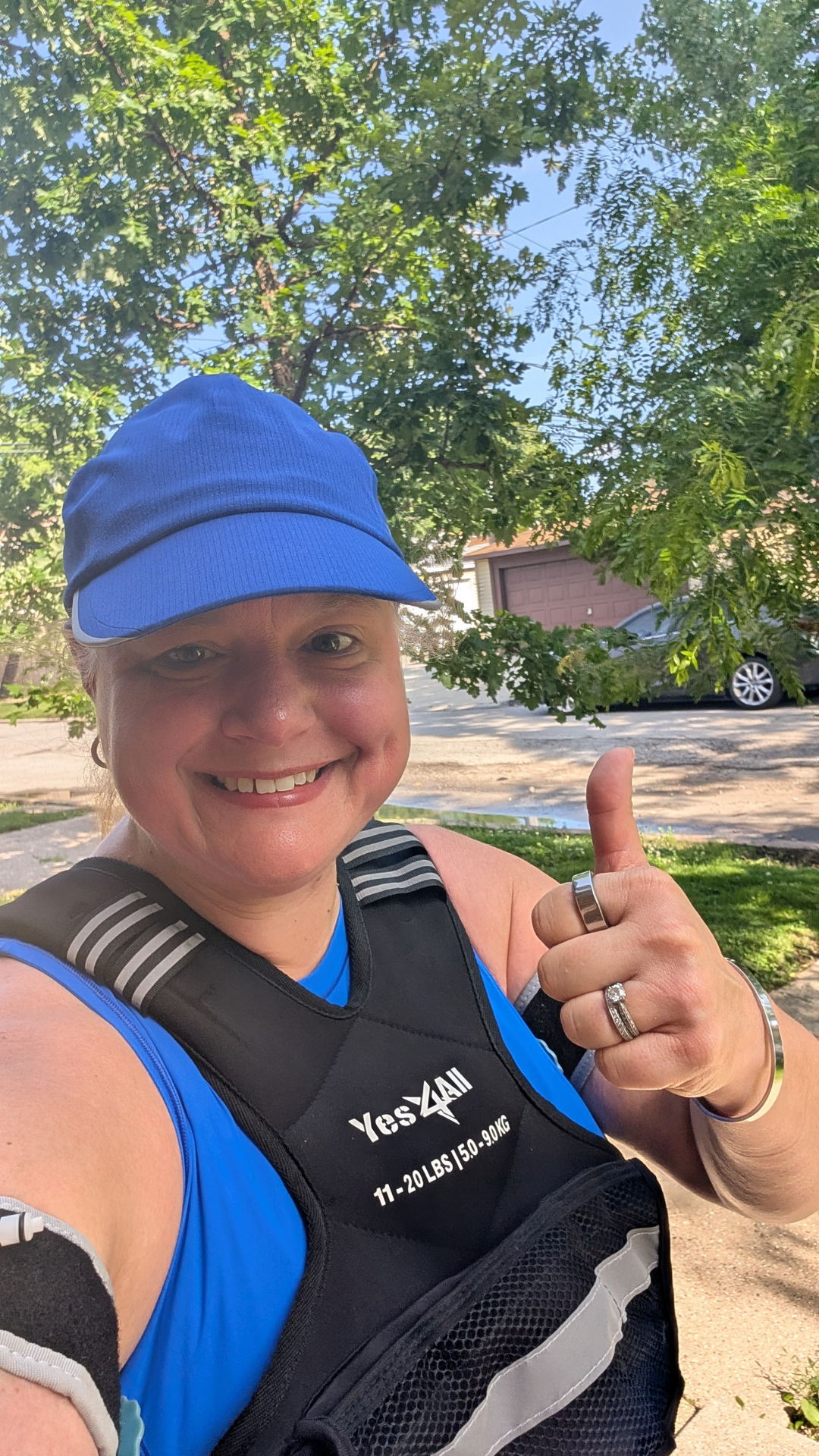
I’ve resumed some weighted-vest work. The vibration plate is still waiting. I’m continuing my hand and grip exercises, walking, movement snacks and other activities my body tolerates.
I'm also planning to resume the ProLon cycle I postponed when the timing feels right. If you've been curious about ProLon and want to join me for my next cycle, you can learn more or purchase it through my practitioner link here (code LORIDIAMOS applies the best available discount). I'm a ProLon practitioner partner, so if you purchase through my link, I may earn a commission at no extra cost to you.
And yes, being able to blow-dry my hair again counts as progress too.
I’ll keep tracking my readiness, Oura information and Hume measurements as I rebuild. This experiment isn’t over. I’m just less convinced that its most important result will be a visceral fat number.
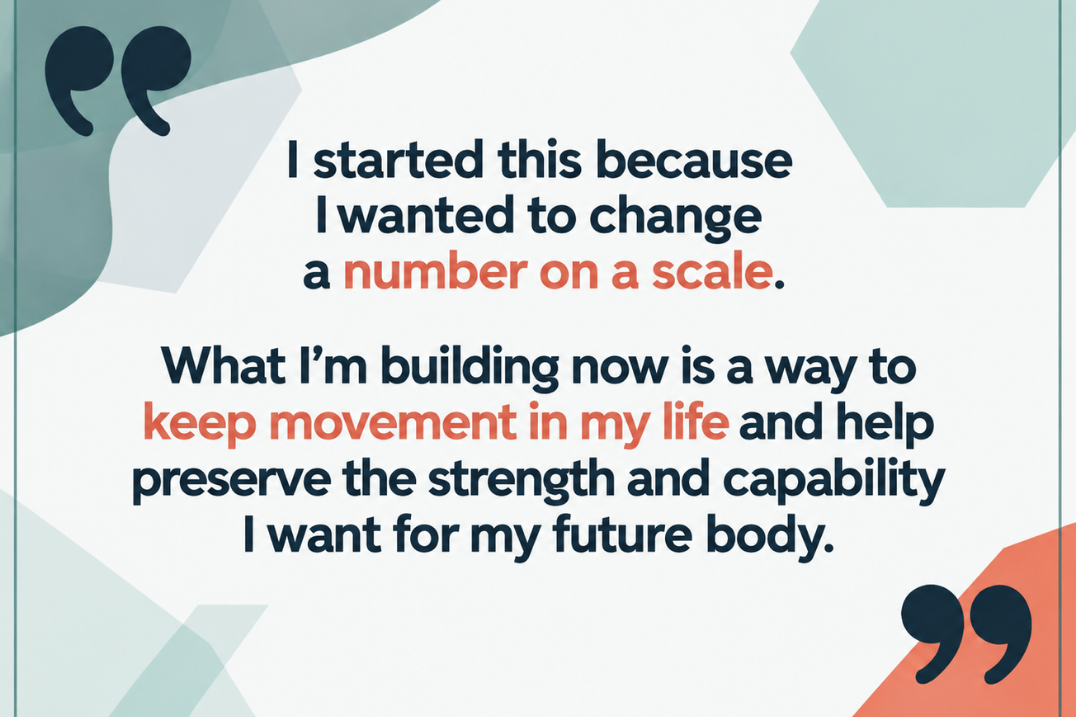
I started this because I wanted to change a number on a scale. What I’m building now is a way to keep movement in my life and help preserve the strength and capability I want for my future body.
Maybe that’s the needle that matters most.
To smarter health through strategic movement,
Lori
Your Movement Detective
P.S. Enjoyed this Pearl of Wisdom? Don't miss the next one! If this was forwarded to you,[click here] to subscribe so you get every new post sent directly to your inbox.


