Why I'm Hitting Reset Before the Holidays, Not Waiting Until January
What this year taught me about midlife health, small movements that add up, and making the most of the weeks we have left.
Disclosure: This post includes an affiliate link to ProLon. If you purchase through my link, I may earn a commission at no additional cost to you. I only share products and experiences I believe are worth discussing.
November is here, and I've been doing something I usually associate with the end of December. I'm looking back at the year and asking myself what worked, what didn't, and what I want to do differently.
Not because I'm ready to write off the rest of 2026. Quite the opposite.
There are still weeks left in the year, and I don't want to spend them waiting for January to give me permission to make a few changes.
This year has given me plenty to think about when it comes to my own health. I've dealt with a neck injury, adjusted my exercise routine, paid closer attention to my metabolic health, and reminded myself more than once that knowing what to do doesn't automatically make it easy to do it.
Even physical therapists need that reminder.
Why Wait Until January to Take Stock?
We tend to treat January 1 as the official starting line for better habits. New calendars, new goals, new routines. There's nothing wrong with that, but I've started to wonder why we give the last two months of the year so little credit.
November and December aren't necessarily easy months. Schedules get crowded, travel picks up, and the holidays bring their own mix of joy and stress. But that doesn't mean they're useless for making progress.
In fact, they might be the perfect time to look at what your real life can support.
Rather than making a long list of things I want to change next year, I'm asking a simpler question: What could I adjust right now that would help me feel a little better heading into the holidays?
Sometimes the answer isn't a new program or a major commitment. It's noticing something that's already within reach.
What My Neck Injury Reminded Me About Movement
My neck injury changed the way I approached exercise this year. I had to pay more attention to how I was feeling, adjust what I was doing, and accept that some days required a different plan.
That can be frustrating when you're used to being active. But it also reinforced something I've told patients and clients for years: Movement doesn't have to look exactly the same every day to be worthwhile.
You can change the exercise, shorten the session, reduce the intensity, or work around a limitation. The goal is to find a useful way to keep moving rather than deciding the entire day is a loss.
I've written more about that in Exercise After Injury: Adapt Your Workout.
Before You Choose a Workout, Check Your Readiness
One thing I encourage people to do is pay attention to where they're starting before deciding how they're going to move.
That's the idea behind my 60-Second Readiness Check. It helps you consider three things: your battery, your bandwidth, and the time you realistically have available.
Your battery is how much physical and mental energy you're working with today. Your bandwidth is how much you can reasonably take on with everything else happening in your life. And your available time matters, too.
When you put those pieces together, you can make a more informed choice about the kind of movement that fits your day.
Maybe you have the energy and time for a longer, traditional workout. Maybe a shorter, strategic movement session makes more sense. Or maybe today is a day when one to three minutes of intentional movement is a realistic starting point.
If you're not sure where to begin, try my 60-Second Readiness Check.
It gives you a quick way to think about your options before you start.
We often start by looking for a 30-, 45-, or 60-minute opening in our schedules. When we can't find one, movement gets pushed aside.
But what if we reversed that thinking?
What if we started with the one to three minutes we already have scattered throughout the day, then built from there when time and energy allow?
That brings me to the smaller movement opportunities I've been paying more attention to lately.
What If You Stopped Waiting for a 30-Minute Opening?
A full workout has value. I still believe in making time for strength training and cardiovascular exercise.
But a workout isn't the only movement that counts.
If I take four three-minute movement breaks during the day, that's 12 minutes of movement I might otherwise have spent sitting. On a long workday, taking a three-minute break roughly every hour could add up to 30 minutes.
That doesn't mean every movement break replaces a structured workout. Adults should still aim for at least 150 minutes of moderate-intensity aerobic activity per week, along with muscle-strengthening activities on at least two days.
The point is that the smaller opportunities matter too.
A few minutes of walking, changing positions, doing mobility exercises, or waking up muscles that haven't been doing much can help break up long stretches of sitting.
And if your schedule is already packed, that may be a much more realistic place to start.
I explored this idea in When Your Workout Is Competing With Your Life.
My New R.E.S.E.T. Method: A Quick Check-In Before You Move
I've been thinking about how to make those short movement breaks more intentional.
Instead of automatically choosing the same stretch or exercise every time, what if you took 30 seconds to notice what your body was telling you?
That's where my R.E.S.E.T. method comes in.
It's a simple way to check in with yourself and choose a movement response that matches what you need at that moment.
R: Recovery
Feeling tired, overwhelmed, or stressed? Choose something gentle that helps you settle down. That might mean easy walking, comfortable movement, or a few slow breaths.
E: Energy
Feeling sluggish or mentally foggy? Try a brisk walk, marching in place, or another short burst of movement that helps you feel more alert.
S: Stiffness
Feeling tight or achy after staying in one position? Try a few comfortable mobility movements for the areas that need attention.
E: Engagement
Do your muscles feel like they've gone offline? A few simple strength, stability, or muscle-activation movements may help you reconnect with them.
T: Transition
Have you been sitting or standing in the same position for too long? Sometimes the best response is simply to change positions and move in a different way.
The process is straightforward.
Check in. Choose what fits. Move for about three minutes. Then recheck how you feel.
You don't need to make every break complicated. The goal is to pay attention and respond rather than staying on autopilot.
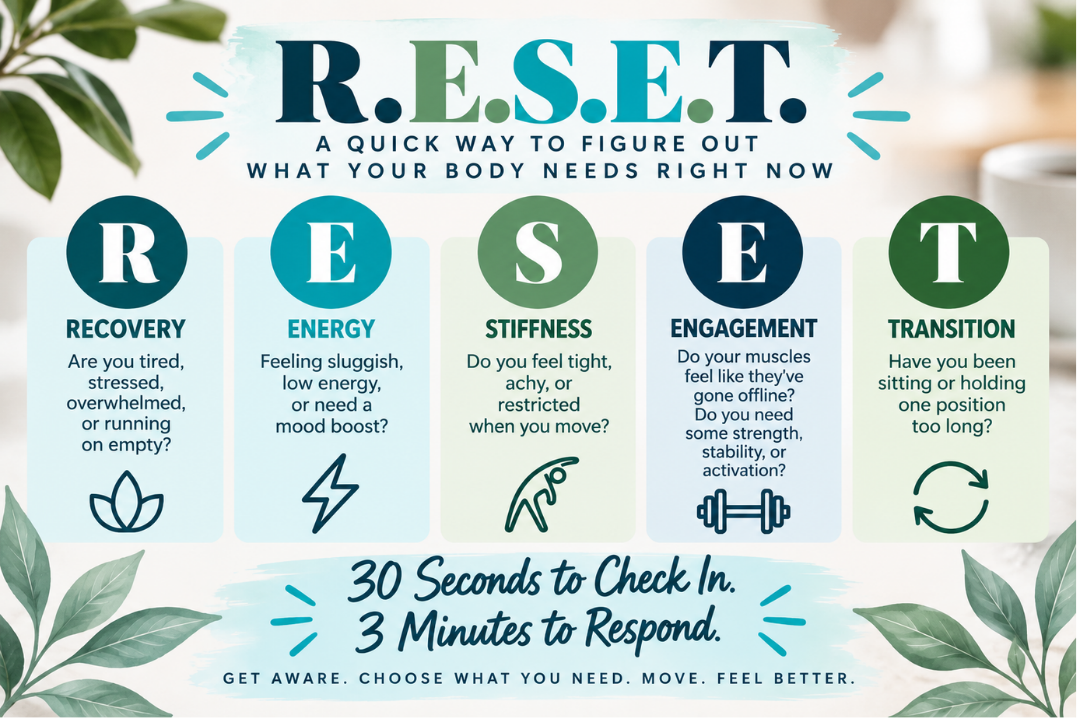
I've also created a free R.E.S.E.T. movement guide that you can keep handy when you need a quick reminder of your options.
Get the free R.E.S.E.T. movement guide here.
A Different Kind of Health Check-In
Movement isn't the only part of my health I've been reviewing.
This year, I started looking more closely at some of the wellness benefits available through my health insurance. That led me to explore Twin Health, a program focused on metabolic health.
As part of the application process, I had bloodwork done.
There was some encouraging news. My A1C had improved. But my LDL cholesterol, total cholesterol, and certain inflammation markers were higher than I'd like.
I didn't qualify for the Twin Health program, which I suppose is ultimately a good thing!
Still, the experience gave me useful information.
With a strong family history of type 2 diabetes and some of the body composition changes that can come with midlife, I don't want to assume everything is fine simply because I'm active.
I want to look at the bigger picture.
That includes how I'm eating, how I'm moving, how I'm sleeping, and what my bloodwork is telling me over time.
It's also why I've been thinking more about the relationship between strength training, muscle mass, and metabolic health.
I've touched on those changes in Same Body, Busier Life: Midlife Metabolism.
Another Benefit Worth Checking Before January
While I was looking into my insurance benefits, I also discovered gym membership options that were worth comparing.
Some plans offer access to lower-cost gyms, while others provide discounts or special arrangements with more expensive fitness facilities.
The options vary, of course, and not every insurance plan includes them.
But if you're thinking about joining a gym in January, it may be worth checking your benefits now.
You might find a membership that fits your budget and gives you access to equipment, classes, or an environment that makes it easier to stay consistent.
And you can make that decision before the January rush.
Why I'm Planning Another ProLon Cycle Before Thanksgiving
Another part of my November reset involves something I've already tried three times this year: ProLon's five-day fasting-mimicking diet.
I'm planning my fourth cycle before Thanksgiving.
One thing I've appreciated about those five days is how much they simplify my food decisions. The meals are planned, and I don't have to spend as much time figuring out what I'm going to eat.
That mental break is a bigger benefit than I expected.
I'm also interested in the research around fasting-mimicking diets and metabolic health. Some clinical studies have reported improvements in measures such as weight, waist circumference, and certain metabolic risk factors.
That doesn't mean everyone will get the same results, and it doesn't mean a five-day program can target a particular type of fat or guarantee changes in inflammation, muscle mass, or long-term disease risk.
For me, it's one piece of a broader approach that still includes regular movement, strength training, nutrition, and follow-up on my health markers.
I also want to be mindful about preserving muscle as I get older. A fasting-mimicking diet doesn't replace the work of building and maintaining strength.
These programs aren't appropriate for everyone. If you have a medical condition, take medications, especially diabetes medications, or have questions about whether fasting is safe for you, talk with your healthcare professional before trying one.
If you're curious about the ProLon program I've been using, you can find it here:
This is my affiliate link, which means I may receive a commission if you purchase through it.
Let's Do a November Reset Together
Here's something else I've been thinking about.
It's easier to follow through when you know other people are making an effort too.
So I'm inviting you to join me for a flexible November health reset, November 9 through 22.
This isn't a challenge where everyone has to do the same thing.
Some people may choose to complete a five-day ProLon cycle if it's appropriate for them. Others might focus on taking movement breaks, getting to the gym, improving sleep, or making a few changes to their eating habits.
You get to choose what makes sense for your body, your schedule, and your goals.
No purchase is required.
The idea is to check in, share what you're working on, and encourage one another. We don't need to wait until January to start making choices that support our health.
Join the November reset.
November Reset Community with Lori.
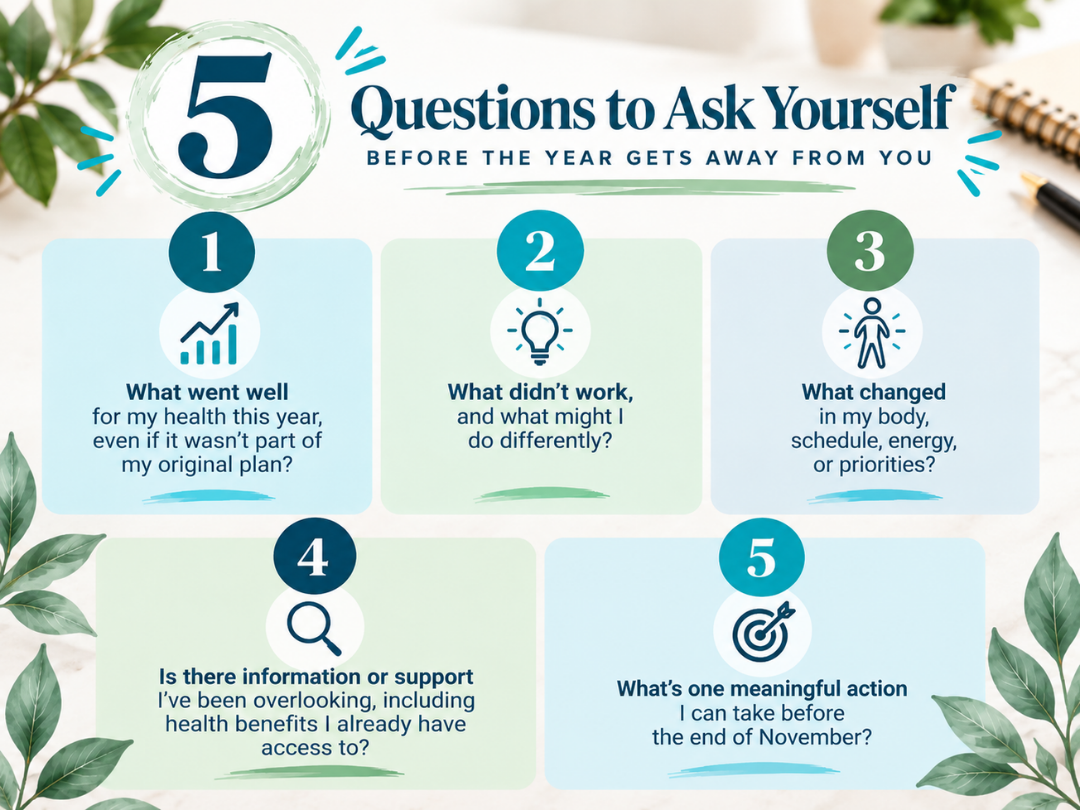
Five Questions I'm Asking Before the Year Gets Away From Me
As I look back at 2026, I'm trying to focus less on everything I didn't accomplish and more on what I can learn from the year I've actually had.
Here are five questions you might want to ask yourself too.
What went well for my health this year, even if it seemed small at the time?
What did I learn from the things that didn't go as planned?
What has changed in my body, my schedule, or my priorities that I need to acknowledge?
What support, resources, or opportunities have I overlooked?
What's one meaningful thing I can do before the year ends?
You don't need to answer all five in one sitting.
You might find that one question is enough to help you see your next step more clearly.
Today's Pearl
The end of the year doesn't have to be a waiting period.
There's still time to recognize what you've accomplished, learn from what didn't go as planned, and make a few adjustments that help you feel better heading into the holidays.
You don't need a perfect plan. You just need to pay attention, choose what matters most, and make the minutes you have count.
![TODAY'S PEARL GRAPHIC]](https://assets.cdn.filesafe.space/d1KY954nTQQaTTgT2eTV/media/6ae8c76af89091cce6505488.png "TODAY'S PEARL GRAPHIC]")
If you'd like more practical movement ideas and midlife wellness insights, be sure to join my email list.
P.S. Enjoyed this Pearl of Wisdom? Don't miss the next one! If this was forwarded to you,[click here] to subscribe so you get every new post sent directly to your inbox.
To smarter health through strategic movement,
Lori
Your Movement Detective


